Complications of Multimedia: The Issues That Plague Journalism


The digital landscape has greatly altered the field of journalism within the 21st century, granting immediate audience engagement and innovative multimedia techniques for storytelling. With that being said, journalists now encounter a variety of problems within this new era.

For one, there is now a lack of clarity regarding who is considered a journalist. According to the Center for Journalism Ethics at the University of Wisconsin-Madison, everyday citizens without journalistic training can now independently produce writings that fall under the general description of journalism. One thing up and coming multimedia journalists like me can do to resolve this confusion is stress important journalistic traits still present in multimedia. For example, if someone I follow on social media highlights a blog post as journalism, I can point out the differences between it and multiplatform journalism – like research, skill with media creation, investigative capabilities, and much more.

Another issue plaguing multimedia journalism nowadays is hateful messaging directed towards reporters. The anonymity afforded by the internet gives users the ability to troll and disruptively attack journalists. In addition, according to The Guardian, a majority of this abuse is directed towards female and minority journalists, citing the ten most abused on their site as falling into these categories. To combat this hateful conduct, there are several courses of action I can take. For instance, if I saw disruptful comments appearing in either my articles or the articles of my colleagues, I can report them to site moderators for their removal, in order to maintain a much more positive and productive news environment.

The question of anonymous sources is also one that hangs over multimedia. With the incorporation of media forms like video and photo, it is harder for individuals to remain hidden, especially protesters out in public streets. According to the Associated Press, journalists have to gain approval from news managers regarding using anonymous sources. I know particularly regarding photographing individuals during public events, I would try to seek their approval to use the media I gathered featuring them or create a happy medium like blurring their faces.

The Benefits of Student Journalism: Why and How To Get Involved

With the Fall 2021 semester being in full swing for SLU and other universities, many students are now looking for ways to get more involved on campus. For those wanting to be informed about campus developments, then the ideal choice would be student news organizations. Independent student journalist organizations provide an opportunity to learn about developments on or around campus, and according to Michelle Peltier, faculty adviser of SLU’s University News, it helps to prepare students to become less closed-off in general.

For many university students, getting locked within a certain sphere while being closed off from the community is relatively easy. Editorial Adviser Michelle Peltier outlines the issue and how student journalism combats it.

Student news organizations like The University News help to foster the civic life of students by keeping them up to date, and according to the Foundation for Individual Rights in Education (FIRE), several of these tasks include informing students of on-campus events, holding school administrators accountable, and even revealing stories that might be missed by larger news outlets. However, without many writers and editors, a news organization cannot properly accomplish this task.

“If we have only 2 or 3 or four writers per section, it limits the amount of things we can actually write about in a given week,” said Conor Dorn, the new editor-in-chief for the University News, citing the flexibility more writers grants a news organization.

With this in mind, how does one join the University’s News Organization? 

The first step is reaching out to someone. At Saint Louis University, the University News website contains a complete list of the emails for each section. One could also email the editor-in-chief or individual editors directly, Dorn said, with the latter especially being encouraged for people who already know what section they want to write for.

One would also have to attend U-News meetings in order to get an idea how things are run. On every Wednesday at 7:00pm, the University News holds in person meetings in Room 353 of the Busch Student Center, Dorn said, for any student who wishes to observe how the organization operates and get a sense of what they can write about. 

In order to get involved with a student news organization, one must be aware of what can be written about for each section. Editor-In-Chief Conor Dorn provides the different sections in the University News and what kinds of articles one might see.

Overall, this year is looking more promising for the U-News.

“We had a number of editors graduate last year, and we had a low number of writers last year,” Dorn said, wanting to build the staff up more for the 2021 year.

For students wishing to broaden their horizon or hone their experience in communications, then it is urgent to support and join student journalism on campus. 

Ferrite App Review

Ferrite Recording Studio, also known simply as Ferrite, is an downloadable app notable for its audio-editing capabilities. According to the app’s summary on the Apple Store, Ferrite promises a variety of editing features, including “move, crop, slice, fade in and out, or crossfade between clips just by overlapping them.” My motivation for downloading the app is my career aspirations, as podcasts are one of the many media platforms that media and film critics take advantage of-outside of online journalistic articles. As someone who is not particularly well versed in audio editing, Ferrite provided an easy outlet to gain some basic knowledge about audio editing.

Overall, Ferrite has a highly usable interface. From one’s own phone, it is effortless to import audio files as well as create new ones within the app. While playing around with the app, I discovered that Ferrite also allowed the importing of songs from Apple Music. Not only were the creation and importation of audio content not too much of a challenge, but the audio editing tools themselves were also relatively easy to decipher-with one exception.

A majority of the audio editing tools-i.e., cutting audio, linking to unconnected audio pieces together, deleting audio clips-can be found by double tapping an audio track. Control over the volume and audio pan of each track can be found in the pop-up menu, as well as additional settings. Trying to separate cut audio tracks was a pain initially as even when I cut an audio clip, the entire track would still be selected  and as a result, the two new tracks would always move together. Despite this, the interface is extremely welcoming to both pros and non-audio experts such as myself.

The free version of Ferrite only permits three separate audio tracks at a given time, and a total recording length of ten minutes, so the content I was able to produce with it was a mini-podcast created out of an audio interview I did with Matthew Kowalski for the first blog. While admittedly not the best example of podcasting, it is still relatively well organized and does feature music from Phillip Phillip’s song, “Home.” You can check out the podcast here.

Overall, I found Ferrite to be an incredibly useful tool for audio editing. I will most certainly continue using the app well after my college career given its friendly interface. In a journalistic setting, I will most easily be able to use this app to edit interviews together, as well as generate podcasts in which I can explore various media-related subjects in-depth.

Multiplatform Journalism: What is it?

While journalism and newsrooms of old might have thrived on putting out newspapers for local citizens on stands, it is abundantly evident that the journalism field has grown much more complex with the emergence of new technologies. According to Poytner, the American Society of News Editors (ASNE) has stopped trying to gage the total number of jobs lost in American newspaper rooms, citing the changing structure of modern newsrooms. In this day and age, journalism, according to a story craft by Nieman Storyboard, must be dynamic: integrating the various technologies-whether that be audio like podcasts or visual like videos-to build “a narrative environment for the user.” This is multiplatform journalism, which combines classic journalistic instincts-such as the organization, verification, and accurate presentation of information-with various media forms-including text, audio tracks, videography, and photography-for an immersive experience. A multimedia journalist is someone who can adequately blend all of these elements together into a cohesive, captivating experience, whilst at the same time being able to market these multimedia works across several social media platforms like Twitter or Instagram. 


According to Mindy McAdams, digital journalism professor at the University of Florida, the marks of good multimedia journalism are that each piece of media feels integrated and connected with each other to create a flowing story, where “each one [of the media types] is used in a way that makes the most of its strengths.” Conversely, underwhelming multimedia pieces are characterized by redundancy or prioritizing one media form over another, with McAdams saying, “Don’t marginalize the visual media.” One example of the latter would be a review of the 2019 remake of “Pet Sematary” from IGN, an entertainment news website. At first glance, it would seem that the article incorporates a good deal of media types, such as a photo gallery of images from the film, giving viewers a sample of its aesthetics. However, upon closer inspection, much of the media operate more so as tangents-like a feature about why Church the Cat is a horror icon or a video comparing the original 1989 film and the book, but not the 2019 movie. Then there is the main video review, which mostly repeats verbatim what is said in the text, making the video kind of pointless. The article would have been much better off making each media piece feel more connected and co-dependent on one another, which would have created a more immersive experience.

A Line Drive to Sports Business: Meet Matthew Kowalski

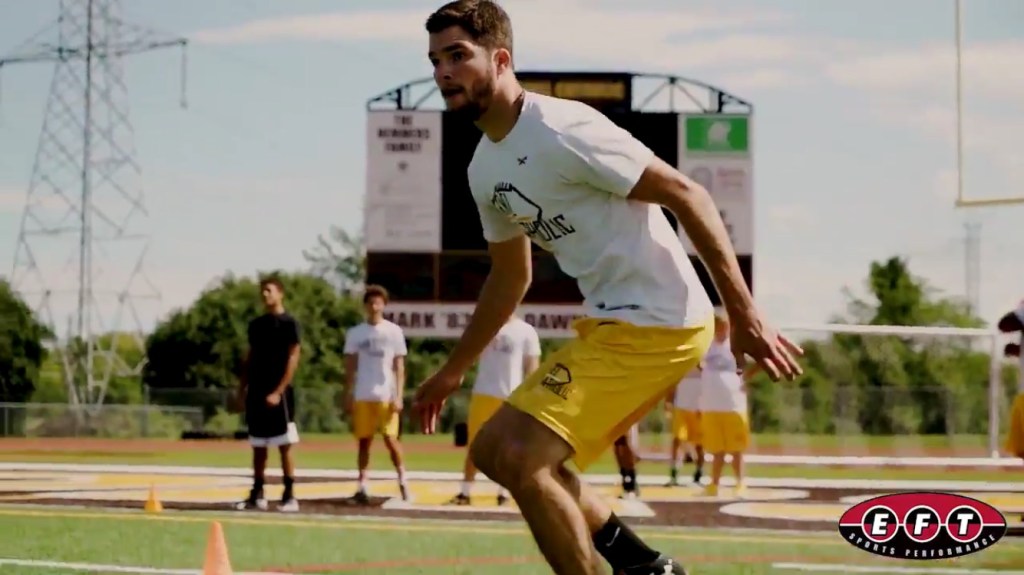
ST. LOUIS, MO-Enthusiasm, Caringness, and Ambition. These three characteristics are invaluable within any career field, and in the case of Matthew Kowalski, they have provided a clear road towards the Sports Industry. Since his early years growing up in Chicago, IL, Matthew has been entrenched within the world of sports, with both his parents being avid sports fans and his father even being a college athlete. Matthew has played sports, such as baseball and football, for many years-playing the former since the age of three-and even coached his sister in basketball until she reached high school.

Matthew strongly values building relationships, investing great amounts of time establishing rapport with each person. This actually led Matthew to pursue a career in Public Relations.

“My college counselor suggested that PR might be a good outlet for me since I built relationships with a lot of people. ”

Currently, Matthew studies at Saint Louis University, with a Major in Communication-concentrated in Advertising and Public Relations-and a minor in Sports Business. Matthew serves as a Student Business Assistant for SLU’s Athletic Department while also working for a Professional Sports Team. Matthew has also helped build an NCAA Coach Database for WME agency and USA today.