Award-winning journalist and Race-Card Project founder Michele Norris delivers speech

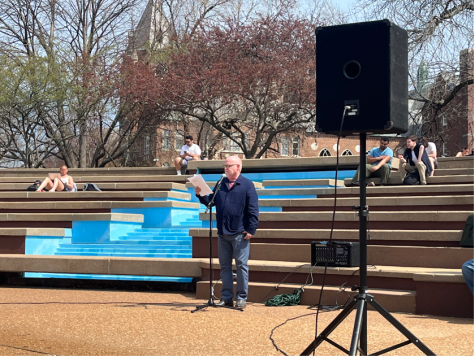
Michele+Norris+speaks+at+the+Busch+Student+Center+on+April+4.+%28Mark+Burbridge%2F+The+University+News%29
(Mark Burbridge / The University News)

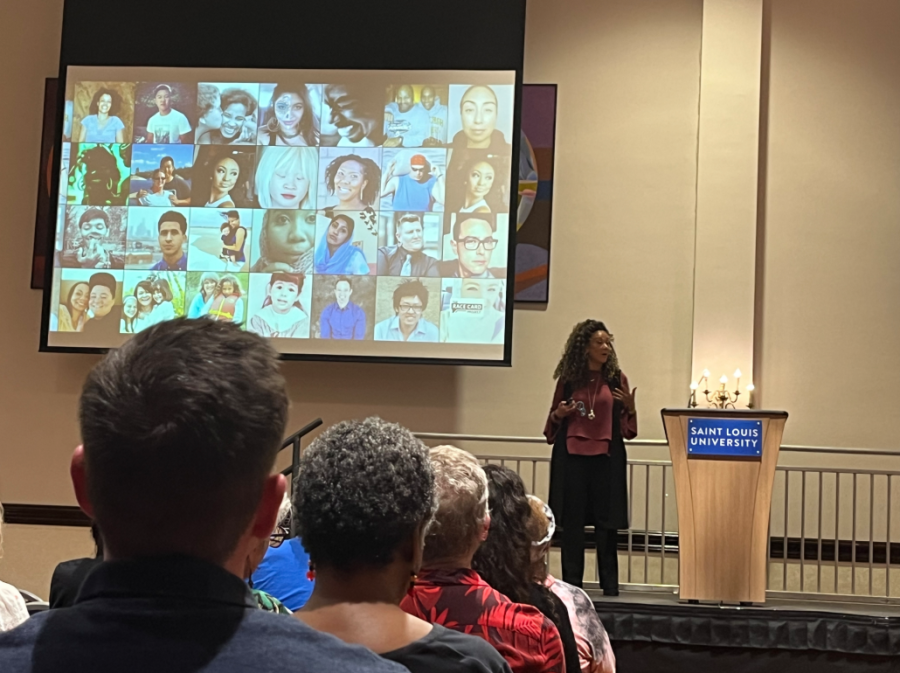
Michele Norris, award-winning journalist and founder of the Race Card Project, delivered a keynote speech in the Saint Louis Room of the Busch Student Center on April 4. Norris, who has worked in the journalism field for four decades, began the Race Card Project in 2010, which invites individuals to initiate conversations about race through six-word postcards which described their identity and experiences. Her message is to build bridges through differences.

“I think it is the greatest challenge for the next generation of young people,” Norris said. “In order to lead, you have to figure out how to deal with people who don’t agree with each other and are roaming in different directions.”

The keynote speech was the result of a collaborative effort between the College of Arts and Sciences, the Division of Diversity and Innovative Community Engagement and the Department of Communication. Dan Kozlowski, the chair of the Department of Communication, said that he had thoughts about inviting Norris to SLU since the Spring of 2021. In the aftermath of the murder of George Floyd and the conversations about social justice that followed, Kozlowksi said that he was looking for ways to hold discussions on race, culture and identity within the department.

“A colleague of mine, who then was at Wayne State, informed me that Michelle Norris was visiting there virtually through a Zoom webinar,” Kozlowski said. “I went and listened to Michelle Norris’s presentation at Wayne State, and it was amazing. I wanted to bring Michelle Norris to SLU.”

After attending the webinar, Kozlowski said he began the process of getting approval from the College of Arts and Sciences. Katrina Moore, the associate dean of diversity, equity, inclusion, and engagement, says both the Colleges of Arts and Sciences and DICE also saw that same potential for productive discourse on-campus. 

“The six words often tell a story that we don’t know, and that is what makes it very interesting,” Moore said. “It is very important to understand how people see themselves in their own experiences.”

In spite of several complications that arose as a result of COVID-19 variants, the event was finally set for the Spring 2023 academic semester. Kozlowski, speaking about the overall process it took to host Norris’ keynote speech, said that he is grateful for all the help received from Moore and Aubra Ladd, the program coordinator for DICE.

“There’s a lot of moving parts for an event that is just a handful of hours when Michelle Norris is here,” Kozlowski said. “Katrina has been wonderful [to work with], and then Aubra Ladd… [she and DICE] has done wonderful work around campus.”

The Race Card Project presentation on SLU’s campus had begun to occur even before Michelle Norris set foot on university grounds. The three sponsoring organizations shared with the SLU community a form by which students could submit their own six-word stories. From 12:00-1:00 p.m. on the day of the speech, these stories were read anonymously by the Fine and Performing Arts Department at the SLU Clocktower.
(Mark Burbridge/ The University News)

“I think it is important at Saint Louis University, a school that is built on social justice and men, women and persons for others, that we understand how people understand their own experiences and culture,” Moore said. “We have about 127 responses from our SLU community, and we would love to continue this.”

This large partaking in the Race Card Project served as a prelude for Norris’s later keynote speech. The event, starting at 7:00 p.m., saw a mass of students, staff and other members of SLU’s community.

Paityn Upton, a junior student studying social work, said she attended because it represented a chance to engage in meaningful conversation about race.

“One of my teachers for multiculturalism had told us about it in class, and I wanted to come,” Upton said. “It is part of my major… I think it will be a great learning experience for everyone.”

The crowd remained seated as Moore delivered an introduction on Norris and the Race Card Project. When Norris came to the stage after the introductions, she extended her gratitude towards those in attendance and explained why she chose to initiate this project.

“I am a story collector, and I now lean into that second half of my role with a little bit more gusto,” Norris said. “I avoided race for much of my career, and I was a little bit unhappy with how many of the newsrooms I worked in covered race, because it was ancillary.”

Norris, walking across the stage and gesturing to the audience, then went on to describe her observations during 2008, specifically around race, both in the white public sphere’s notion of a “post-racial” society after Obama’s victory and the conversations she was having in her own circles.

“America had entered a really interesting phase… in the public sphere [it] was around this notion that we were entering this new phase of American life,” Norris said. “Post-racial was a word that entered the vernacular with unusual speed, only being used a dozen times in popular culture before 2006… [treating race in] the [same] way you put stuff in a drawer.”

Sharing her skepticism regarding the concept of “being done with race,” Norris turned it over to the audience, enabling an expression of their thoughts, stories and reactions towards this outward perception of racial identity. In a continuation from the early performance at the Clocktower, Norris shared some sample stories from the race card project: “Not comfortable in my own skin,” “I’m not the paralegal, I’m counsel,” “Don’t think of you as Asian” and other stories. As the audience was engaging with these short, yet complex messages of identity, Norris ended with a message of understanding.

“My six words are, ‘Still more work to be done,’” Norris said. “We need to figure out how to listen to each other and build community with each other, even when we don’t agree, and I believe it starts with listening.”

Jennifer Xa-Que, a freshman student, said that this opportunity to engage with the dynamic stories resulting from the Race Card Project was deeply beneficial.

“Just being able to learn a lot from her [was a great experience], it was a really big event,” Xa-Que said.

Speaking after the event had concluded, Norris said to the University News that she found the large turnout for the speech, especially post-COVID, to be quite heartening.

“At a moment where as country we are divided, confused and constricted, I’m glad that people came to listen and share their stories, and they came with questions,” Norris said. “I try to help people see not just my point of view, but introduce them to new ways of thinking… I’m always thinking about blindspots: who am I not hearing from.”

However, harkening back to her own six words, Norris said that there is more that she wishes to do for this project on SLU’s campus.

“I plan on coming back,” Norris said. “I know that [SLU has] done the Race Card Project here, and I think it would be wonderful to work more closely.”

This article was initially published on the unewsonline.com on April 11th, 2023. Click here for the published article.


“Blockbuster” Review: A Block-Bust

Image Courtesy of IMDb

Throughout the 1990s and early 2000s, Blockbuster was the go-to video rental service. Through the assistance of investment groups and eventual Viacom ownership, Blockbuster was able to expand its horizons from a solo store in Texas to an international conglomerate. At its peak, the video-rental giant boasted a total of 9000 stores worldwide, reaching a market value of $5 billion. However, the advent of Netflix, with their pioneering DVD-subscription service and eventual streaming platform that brought forth many similar services, signaled the end for the once powerful retail service.

Fast forwarding to present day, in what probably counts as corporate spite, Netflix turns to its vanquished rival as the subject for its new workplace-comedy series, simply titled “Blockbuster.” Created by Vanessa Ramos, known for her work with shows “Brooklyn Nine-Nine” and “Mr. Mayor,” this new series takes viewers to a Blockbuster store in Michigan in the immediate aftermath of the corporation’s collapse. Timmy Yoon (Randall Park) struggles to keep the store alive as a small business, all the while keeping together his crew of workers: Eliza (Melissa Fumero), Carlos (Tyler Alvarez), Connie (Olga Merediz), and Hannah (Madeleine Arthur).

Every good workplace comedy should take advantage of its unique setting, and “Blockbuster” does a decent job of utilizing its movie-based setting. Film and television references are littered across the series, with the pilot episode’s opening alone containing allusions to “Independence Day,” “Smallville,” “Ferris Bueller’s Day Off,” and “Eternal Sunshine of the Spotless Mind.” None of these allusions feel too hamfisted, which is aided by some of the characters’ unique connection to cinema, with Carlos and Timmy being the most noteworthy. Carlos is an aspiring filmmaker who learned to speak English through viewing movies and reading reviews, yet he struggles to pursue that dream due to the limitations of being the child of immigrants. Timmy worked through his parents’ divorce by watching movies and his desire to build a cohesive family is tied to his desire to work at Blockbuster. 

However, while Carlos and Timmy possess conceptually interesting angles to analyze, some of the other characterizations feel slightly generic. Connie mostly represents the old goof archetype, a trait that can wear itself thin, especially during the seventh episode, “Intimate Angels.” Hannah is mostly characterized as the kindhearted simpleton, which like her spending habits, is quite cheap. Lastly, and most notably, Eliza is basically an inferior carbon copy of another Melissa Fumero character, Amy Santiago, in that both are over-achievers with relationship troubles who are overqualified for their current job. While none of these characterizations are unbearable, the jokes that result from them do not land as they should, especially since some of these same tropes are done better in other shows. 

Speaking of carbon copies, the romantic dynamic between Timmy and Eliza is unoriginal. To summarize it in one sentence: guy holds long-time crush on female coworker, but has trouble expressing it as a result of her existing romantic connections. If that sounds familiar, it’s because it is the same romantic narrative featured in many other workplace sitcoms, such as “The Office” and “Brooklyn Nine-Nine.” The entire dynamic has a “been there-done that” vibe, and is only made worse by the fact that every action made by Timmy (the main character) boils down to this retreaded storyline, regardless of the episode. It detracts from the show’s premise of being the last of a dying age, as the attraction is not even tied to their history of working at the store. With no new spin, the Eliza-Timmy subplot can just be written off with a certain “Back to the Future” quote: “Hey, I’ve seen this one.”

As previously mentioned, the humor does not always fit. One notorious example is a running-joke about Timmy being affected by his parents’ divorce, which is used multiple times across all ten episodes. Its excessive use becomes irritating to hear, with the viewer wishing for the show to change the subject. There is also a missed chance of meta-humor, considering the show unironically preaches “human-connections” whilst being distributed on the platform that fostered digital viewing. It could have been a chance to do something different and funny, as opposed to relying on old tropes to elicit laughter.

In the end, while the movie references are appreciated, “Blockbuster” feels better in conception than it does in execution. With many elements ripped straight from other shows, with half the care, it feels as though “Blockbuster” could have been set anywhere and still feel the same, which is the worst thing an office sitcom can do.

This story was originally posted on Nov. 10th, 2022 on unewsonline.com. Click here to view the original story.

“Godzilla vs Kong” Movie Review: Of Monsters and Men

Poster Courtesy of IMDb

King Kong and Godzilla are without a doubt the two most famous movie monsters of all time. The two colossal titans first battled on-screen in 1962’s “King Kong vs Godzilla,” but since then, fans have been clamoring for a rematch between the two kaiju with the updated visual effects of modern cinema. In October 2015 when Legendary and Warner Brothers Pictures announced plans for a shared “MonsterVerse” with the two monsters culminating in “Godzilla vs Kong,” fans were naturally met with high expectations. 

After several delays, “Godzilla vs Kong” has finally arrived in both theaters and HBO Max. Set five years after the events of “Godzilla: King of the Monsters,” the film follows the attempts of Dr. Nathan Lind (Alexander Skarsgård) and Dr. Ilene Andrews (Rebecca Hall) to use Kong to access the Hollow Earth where all Titans live, whereas Madison Russell (Millie Bobby Brown), Bernie Hayes (Brian Tyree Henry), and Josh Valentine (Julian Dennison) seek to explain Godzilla’s sudden rampages.

One thing this movie can certainly be commended for is living up to its promise of a titanic battle between these two colossal beasts. Both sequences in which Godzilla and Kong do battle are great spectacles to watch, with great fight choreography that makes good use of both each monster’s abilities as well as the environment. The first battle takes place in the middle of the ocean on a Navy convoy, showcasing how Godzilla’s aquatic nature gives him leverage over Kong. The second battle in Hong Kong is much more evenly matched, with Kong using his better agility to leap across the cityscape while Godzilla relies on brute force and his Atomic Breath. The destruction present within both sequences adds to the spectacle of each fight, creating a sense of scale and always drawing attention to whatever is happening on-screen.

The film’s original soundtrack also fits the tone that director Adam Wingard tries to hit. The overall tone can be best described as intense or grandiose, but the individual themes always fit alongside their accompanying scenes. The opening theme—titled “Pensacola, Florida”—has a slow, heavy beated overtone that mirrors the Godzilla films of the 80s and 90s, with a quicker-paced undertone to portray the imminent threat present. Other themes in the movie, such as “A New Language,” are quieter tones which slowly increase in volume to emphasize the revelations that occur in the film.

In spite of the spectacular battles, the plot that sets up these confrontations is less than stellar. While the basic premise of the film—Monarch researchers attempting to access the Hollow Earth ecosystem in which the monsters originate and a smaller group attempting to discover the reason behind Godzilla’s rampages—sounds all right on paper, in execution these ideas become absurd. One example is the film’s portrayal of the Hollow Earth, which feels somewhat contrary to how it’s described in “Kong: Skull Island” or shown in “Godzilla: King of the Monsters.” Instead, the Hollow Earth plot almost feels like a rejected “Journey to the Center of the Earth” script that somehow was integrated into this movie, breaking the continuity and rules established within the diegetic world of the MonsterVerse. Some of the technology in this film’s world also seems to have advanced hundreds of years since the last movie even though it’s only been five, which makes it feel difficult to connect the rules of the previous movies to this one.

This inability to establish verisimilitude in the plot is not aided by the mediocre human characters within the film. While the dynamic between Dr. Andrews and Nia (Kaylee Hottle) does have some level of intrigue, the trio of Bernie Hayes, Madison Russell and Josh Valentine is straight up annoying. The film mostly attempts to portray them in a somewhat comedic manner, though this intended effect is not achieved. Walter Simmons (Demián Bichir) and Ren Serizawa (Shun Oguri), two prominent members of the newly introduced corporation known as Apex Cybernetics, are also relatively bland. Obviously Oscar-worthy performances should not always be expected for these types of films, but a good enough human plot can help ground the film and captivate viewer attention when the monsters are not present. Other Godzilla and King Kong movies managed to portray this facet, yet in this film the non-action sequences are dreadful.

Overall, “Godzilla vs Kong” is somewhat of a mixed bag. Despite its incredible action sequences and musical scores, the set up to get to those sequences is a major drag with in-universe rules that break suspension of disbelief. If you want to watch a grand smackdown between these two iconic monsters, then this movie is worthwhile. However, “Godzilla vs Kong” is the weakest entry of the four MonsterVerse films.

This story was originally published on April 12th, 2021 on unewsonline.com. Click here to view the original story.

The TV Shows that Kept Us Sane During the Pandemic

The+TV+Shows+that+Kept+Us+Sane+During+the+Pandemic
Photo Courtesy of Celia Searles / The University News

With the current state of the world still under the threat of the COVID-19 pandemic, many individuals have lost a great deal of the things they used to take for granted: the friends they could see regularly, in-person social events, proper in-person education that fostered clear communication between instructor and student and much more. When life has been so limiting in the things one can do, it is only natural that many individuals have turned towards mediums like television shows to keep some semblance of sanity during these unpredictable times. 

Whether they be documentaries that provide opportunities to learn or fictional stories with captivating worlds, television series have become a prominent form of escapism in these depressing times of isolation. UNews reached out to several students who shared the TV shows that maintained their sanity during the past year; should you find yourself in another pandemic ever again, here is what you can watch!

The West Wing

“The West Wing” is a political drama that first premiered back in September of 1999, and ran for seven seasons before ending in May of 2006. The show, primarily focusing on the west wing of the White House, follows the fictional presidency of Josiah Bartlet as he, along with his White House Staff, handles the day-to-day tasks of governmental affairs. This administration is forced to balance their political and personal lives within the various domestic and international challenges they face.

SLU student Sophie Thibault explained to the UNews how her interest to watch the show stemmed from her American Politics class during her freshman year at SLU. “My American Politics professor freshman year loved it, so he had gifs of it on slides and we would watch clips of it to explain things we were learning in class,” Thibault said, “once COVID happened at the end of my freshman year, I decided to watch it to see what the fuss was about.” The blend of comedy and drama within the show was also something that held Thibault’s interest, “The drama comes from the big decisions that had to be made, and there is no right answer to go about it; The comedy comes from the characters working together…they work together for so long, they have little inside-jokes to balance the light-hearted and heavy stuff.”

Tiger King

While it probably would have died out as an obscure documentary series under any other circumstance, one still has to acknowledge how the release of “Tiger King” at the beginning of the pandemic helped provide a distraction for many. The show is a true crime documentary series detailing zookeeper and convicted felon Joe Exotic, as well as his feud with Carole Baskin of Big Cat Rescue.

The instant popularity of the show is what helped to grab photo editor Andrea Porter’s attention. “It was one of my Netflix recommendations and I saw that it was in the Top 10 shows to watch,” Porter said, “ I was interested in what it was about.” Porter said that untamed and uncut shows about people with exotic animals had always been an attention grabber, and how in spite of the fact that it is not the type of show to rewatch multiple times, “if a new season came out I would watch it!”

Schitt’s Creek

“Schitt’s Creek” is a Canadian sitcom that first premiered in January of 2015 and lasted for a total of six seasons, the last wrapping up in April of 2020. The show follows the wealthy Rose family relocating to a small rural town known as Schitt’s Creek following the loss of their fortune from an embezzlement scandal. From there, they begin to grow as a family and learn to live alongside the other residents of Schitt’s Creek.

As for what made this show captivating, one anonymous SLU student wrote to UNews that the humor was a big attention grabber. “This is a show that made me genuinely belly laugh out loud,” the student told UNews, “[it] is also incredibly heartwarming while talking about important topics related to modern society.” According to the student, the atmosphere built by the show helped provide for great escapism, “It helped distract you and take you away from the world you were currently living in. Very engaging!”

The Office

Given its popularity, it should be no surprise that “The Office” has provided some students with sanity they needed during this pandemic. The nine season mockumentary sitcom details the workings of paper company Dunder Mifflin run by branch manager Michael Scott and follows the various dealings within this unusual paper and office supply’s sale company.

Another anonymous SLU student told UNews that the various character dynamics throughout the show is what made it especially interesting. “The Office has evolving relationships,” the student said, “and crazy situations that always keep you on your toes.” Indeed, the ever-changing relationships between characters would certainly provide solace in a time when one cannot easily achieve these social interactions, and the student echoed this sentiment with, “The Office has always been my go-to and felt like my safety show during the pandemic.”

Bridgerton

The most recent television show reported by SLU students, “Bridgerton” is an eight episode period drama set within Regency Era London. The Netflix series follows the wealthy Bridgerton family, specifically the eldest daughter Daphne, as they try to enter her in the competitive marriage arena of 19th century London.

The beautiful way in which the show portrayed its time period was highlighted by one anonymous upperclassman. “I loved being able to see how the scenes were decorated and the wardrobe that people may have worn back in the 1800s,” an upperclassman shared with the UNews, “It’s fun to imagine the past and compare it to how things have drastically changed.” Depicting a time period different from our current COVID-19 dominated world was not the only thing noted, as the diversity of the cast was also found to be appreciated, “Not many period dramas have any sort of diversity, but this show did!”

This story was originally published on Mar. 29th, 2021. Click here to view the original story.

Vaccine at SLU: Where Are We Now?

Photo Courtesy of Grace Dunlavy / The University News

On March 5, Saint Louis University issued a message to notify all students and staff that the University had acquired more doses of the Moderna COVID-19 vaccine by way of the Missouri National Guard. This announcement also had a survey for students to complete regarding vaccine eligibility. COVID-19 vaccine research and development has been a prominent part of SLU’s plan to handle the pandemic within its own campus. Generally speaking, vaccine research is no small task, a point emphasized by Daniel Hoft, Ph.D., head of the Center for Vaccine Development, who elaborated on the long process of creating the vaccine.

“It starts with identifying a potential target for a vaccine, of course. Is it a big enough problem to develop a vaccine? Are the consequences severe enough that we want to prevent it?” 

After addressing these preliminary questions, “then there is initial preclinical work that needs to be done. You need to know what type of vaccine you’re gonna make: are you gonna make a RNA vaccine, a protein based vaccine, a viral-vector vaccine, virus-like particle type vaccine, or other newer methods?”

When COVID-19 was identified back in the spring semester of last year, there was no question for SLU researchers, led by Hoft, that a vaccine was in order, due to mass disruption it caused through both its infection rate and economic disruption.

“The magnitude in mortality as well as the complications that are occurring in many people in COVID-19, that’s affecting everyone in the world and it’s spreading like wildfire,” Hoft said, “paralyzed our economies, and that has become a divisive force in politics.” 

SLU got right to work researching potential treatments for COVID-19, as well as potential vaccine technology. In March 2020, the same month in which in-person instruction was halted, SLU initiated an Adaptive COVID-19 Treatment Trial to determine the effectiveness of Remdesiver on treating COVID-19—with Remdesiver eventually being approved by the FDA during October. In August of 2020, SLU’s Center for Vaccine Development began recruiting participants for a Phase 3 trial of the Moderna vaccine in order to better understand its efficacy. According to Dr. Horton, by the end of the semester, SLU was monitoring the various research studies that were released. With the release of vaccines from companies like Moderna and Pfizer-BioNTech, SLU began applying through the state to be a provider of COVID-19 vaccines.

“Dr. Terri Rebmann and I led the efforts on that [applying for the vaccine],” Horton said. “We got rejected five or six times before they [the state] finally said we got approved.”

Regarding SLU being an approved vaccine provider for the state of Missouri, Horton noted that the university now stores some of the vaccine for the National Guard.

“It’s a collaborative effort working and speaking with them about our needs, as well as seeing what their needs were,” Horton said. “When the Johnson and Johnson vaccine got approved, they were generously able to give us some of the Moderna vaccine that was given to them.”

Since there are different storage requirements between the vaccines, SLU’s Center for Vaccine Development is involved in organizing the ordering of vaccines and ensuring that there are adequate storage units for whichever vaccine ends up being supplied. Horton elaborated: “They had the ultra-deep freeze to store the Pfizer vaccine, and the vaccine refrigerator for the Moderna [vaccine],” adding, “we had to make two different plans since we weren’t sure which ones we were gonna get.”

As of now, SLU’s distribution of vaccines is based on Missouri’s current phase/tier system for vaccine prioritization. Missouri is currently prioritizing everyone who falls into either Phase 1A or Phase 1B of their vaccination plan: which includes high-risk individuals, first responders, officials required for government continuity, pre K-12 school officials and several other groups. According to Horton, Phase 2 of Missouri’s vaccination plan—which would cover Higher Education officials like the staff and faculty of SLU—will become available on March 29, whereas Phase 3—which would be everyone else who has not yet been vaccinated, including SLU’s student population—will be available by April 9.

Even with the current availability of COVID-19 vaccines, there is still some more research that can be done regarding their effectiveness. Hoft currently lists the top concern for SLU and the rest of the world is keeping up with COVID-19’s new mutated variants.

“These variants of concern are EOC viruses that have mutated, in particular to become more infectious,” Hoft said, “if someone has been vaccinated and developed an immune response to the original virus, the new virus can overcome that by mutating.”

Hoft also noted the necessity of looking more closely at rare side effects reported in COVID-19 vaccines to gain better understanding of immune responses.

“One of the things we’re doing here [at SLU] is starting a trial of a second-generation COVID-19 vaccine that not only targets antibody response, but a strong T-cell response as well.”

This version of the story has been altered to fit AP Style Guidelines. The original story was published on Mar. 21st, 2021 on unewsonline.com. Click here to view to original story

“WandaVision” Series Review: A Wanda-ful Vision for the MCU

Photo Courtesy of Sydney Compton / The University News

With now 23 films and counting, there’s no denying the impact that the Marvel Cinematic Universe has had on popular culture. On Jan. 15, the MCU began expanding its boundaries beyond the silver screen and into streaming with its first Disney+ original series, “WandaVision.” Set after the events of “Avengers: Endgame” and spanning over nine episodes, “WandaVision” details the idealized suburban life between Wanda Maximoff (Elizabeth Olsen) and Vision (Paul Bettany) in Westview, New Jersey. Initially taking the style of a sitcom, Wanda and Vision enjoy their seemingly perfect life, though as events unfold, it begins to seem that this reality is perhaps more illusionary than it appears on the surface.

One of the great accomplishments that “WandaVision” manages to pull off is creating new ways for the characters to grow without making their previous experiences within the MCU seem irrelevant. Nowhere is this done better than with Wanda Maximoff. While audiences did get to know enough about Maximoff’s character from “Avengers: Age of Ultron” and “Captain America: Civil War” in order to make her a compelling side character, “WandaVision” enables the viewer to really understand her in a new way. Wanda’s character is enabled to reflect upon and grow off of her experiences from previous MCU works, with events that were once merely alluded to— like her backstory with her brother Pietro—now worked integrally into the narrative. This is aided once again by Elizabeth Olsen’s stellar performance: conveying the image of someone weighed down by their past, who eventually learns to move forward in order to become all she can.

Of course, the rest of the cast is phenomenal as well. Paul Bettany once again provides an excellent performance as Vision, looking for a sense of identity within this idealized life with Wanda—which considering what happened in “Avengers: Infinity War,” it helps to give a better understanding for how this story is possible. Several MCU characters from previous movies also make an appearance: such as Randall Park as Jimmy Woo from “Ant-Man and the Wasp,” Kat Dennings as Darcy Lewis from the first two Thor movies and Teyonah Parris portraying an older version of Monica Rambeau from “Captain Marvel.” Their inclusion helps to cement continuity with the rest of the MCU, and all of them maintain a captivating presence whenever they are on screen.

Another facet of “WandaVision” that warrants praise is its thematic elements. As alluded to previously, the theme of handling grief is littered throughout the story, particularly how it contrasts Wanda Maximoff and Monica Rambeau. The former has experienced great trauma throughout her life, both in her backstory as well as from previous movies, and in order to initially handle the grief it caused her, she retreats into a state of denial; the latter has also experienced loss with the death of a family member, however she handles it by continuing to press forward fighting for what they believed in, and also helps others, namely Wanda, press on.

The idea of moving on is also brilliantly represented by the evolving sitcom style used to portray the life between Wanda and Vision. When the series first starts, the cinematography is very reminiscent of early sitcoms: with a 4:3 aspect ratio or full screen, background laughing from an actual studio audience, black-and-white colorization and both long and medium shots making up the bulk of the scenes. Then, corresponding with the revelation of events, the show’s visual style changes to match the evolution of sitcoms— such as the live audience being substituted for a laugh track for a couple of episodes—until it eventually reaches to mockumentary style of modern sitcoms like “Modern Family”: more close up shots to highlight emotions, interviews with different characters and an aspect ratio of 16:9. Then, to signify the acceptance of reality, the show switches to the 2:40:1 aspect ratio and traditional lighting seen in the other MCU films.

If there is one minor complaint to be had with “WandaVision,” then it would have to be the character of Tyler Hayward (Josh Stamberg). For a character with a relatively important role, he comes off as generic: there’s minor characterization put into Hayward and when a revelation regarding his character happens, it only serves to make him more disappointing as the show had the chance to do something interesting, but chose not to. Other than that minor gripe, “WandaVision” stands as a fantastic addition to the MCU and is a must watch for anyone with a Disney+ subscription. 

This story was originally published on Mar. 15th, 2021 on unewsonline.com. Click here to view the original story.

Breaking Point or Turning Point: Student Reactions to the Student Development Email

By: Diana Jakovcevic and Mark Burbridge

On Tuesday Feb. 9, Saint Louis University’s Division of Student Development sent out an email to all SLU students about tightening COVID-19 restrictions. It had only been a couple of weeks since SLU students had moved back to campus after a lengthy winter break, eager to see their friends again. It was also just after the 2021 Super Bowl, when many came together to enjoy the sport of football, the various commercials, and to just simply enjoy each other’s company. However, this socialization greatly worried officials at SLU, fearing it would compromise their COVID-19 plans. SLU’s email showcased this fear, with an opening as follows:

“We’re on the brink of implementing severe COVID-19 restrictions because some students, it appears, have just given up. But you can change our minds. How? No more birthday parties. No more large gatherings in off-campus apartments. No more on-campus parties. No beer-pong parties. No Mardi Gras parties. No more hanging out after meals, without masks on, while sitting too close to one another.”

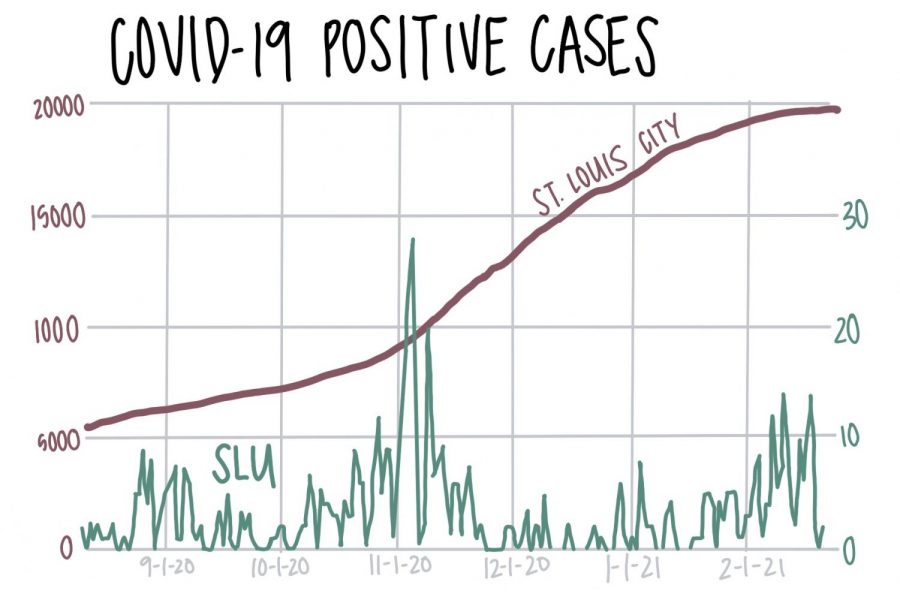
The email detailed various violations of SLU’s public health safeguards, such as 70 complaints about multiple parties, that had increased the number of on-campus positive cases of COVID-19. The email also contained a warning of the more severe restrictions SLU would implement should this behavior continue: Indefinite suspension of building-to-building visitation, suspension of all in-person non-academic events and activities, and closure of recently-opened residence hall lounges and common areas being a few of these restrictions.

Some students were so upset and hurt by the email that they responded to it. Sophomore Selena Mueller wrote a lengthy email explaining how she felt after reading the message. As she explained the lack of respect that she felt, she also went into detail about the things that the university has done wrong and could improve on. “It is not the responsibility of the student body to protect ourselves when we are living in dorms and apartments that lack the proper precautions to ensure our safety.” She further wrote, “Explain to me why every hand sanitizer dispenser in my building is broken. Explain to me why multiple staff members and food workers have refused to wear their masks correctly in the presence of students. Explain to me why SLU did not predict the correct amount of housing for positive cases.”

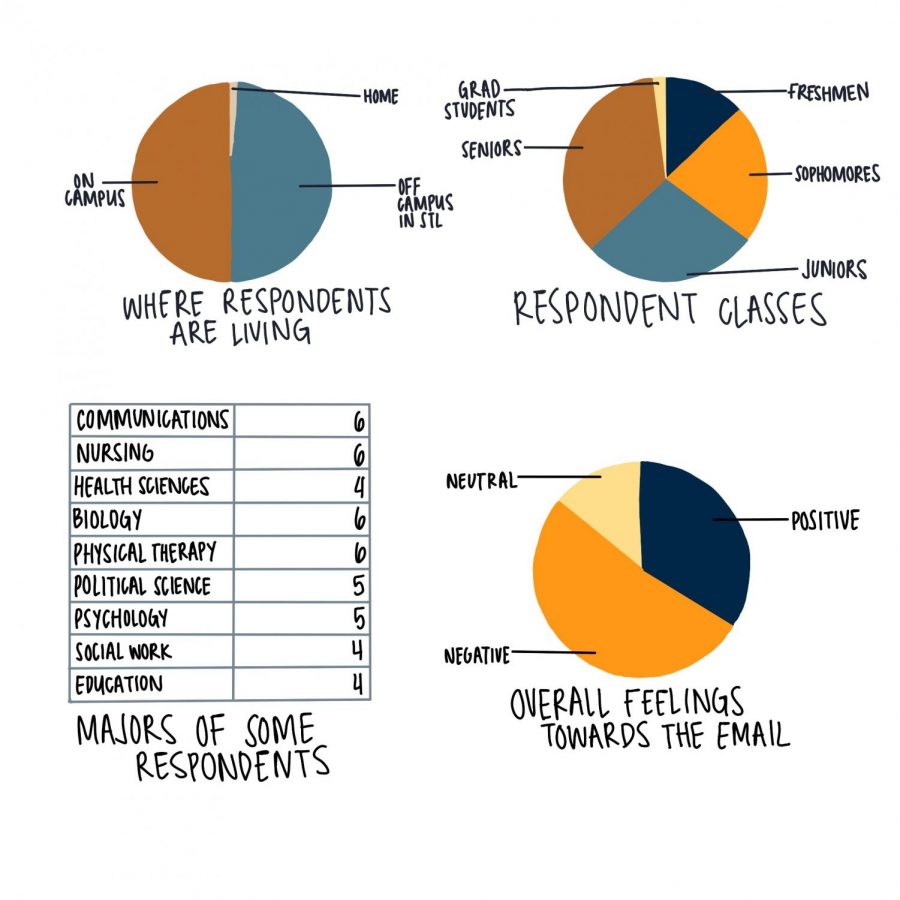
To learn more about the student body’s perspective on the email, The University News put out a survey to collect a diverse range of reactions and opinions. We received 100 responses and read through a myriad of perspectives. 

Respondent Profile

Some students, like Mueller, were upset, while others agreed with what the email had to say. An anonymous senior wrote, “I liked that the problematic students finally got called out. If you didn’t like the email, you are most likely the problem. I’m tired of seeing people get together in large groups and hang out unmasked. I honestly feel like SLU needs to do a better job at reprimanding and punishing students. I’m not looking to have everyone get sent home again [because] a fraction of the student body is being stupid.” 

Several students thought the email was a good way to get the word out about being safer on campus and thought that people were overreacting to it. “I have truthfully been deeply disappointed by the student response to the email from Dr. Lohe,” another anonymous senior said, “I think the email was very tame in comparison to what could have been said to students, as well as compared to some much more drastic measures that have been taken by our peer institutions at other Jesuit universities.”

Other students felt differently.  “I felt that I was being talked down to, and blamed for the ramifications of administration decisions to bring back students in the middle of a pandemic whilst failing to sufficiently acknowledge the mental health and social concerns of students,” said one anonymous junior. 

Some students felt that the email was both helpful and hurtful: “I liked that it was serious, because people need to realize that partying or hanging out in large groups without masks doesn’t only affect them, but the whole student body. However, I think SLU didn’t claim responsibility over the parts they can control.” 

Overall, the majority of the students that filled out the survey mentioned that they felt like they were being talked to like “children” and that the email had been very condescending in tone. Students also felt that the email was quite “accusatory” as Dr. Lohe wrote, “Don’t spend Mardi Gras “day drinking” instead of going to class. (Yes, we’ve heard about that plan.)” and followed up with, “You asked for more mental health days in the calendar, and February 17 is the first one. Use it as it was intended, not recovering from a day of partying.” Several students said they felt that Dr. Lohe had assumed that everybody would be partying and disrupting the university’s COVID numbers.

Additionally, Mueller explained that the email “is perpetuating a culture that turns students against each other,” when discussing the new Integrity Hotline. This hotline was intended for students to anonymously report other students when there were unsafe actions involving COVID-19. For example, if someone found out that someone else had been out partying, they could report them. Several students felt that this could be problematic because students could potentially use this as a way to get people they did not like or perhaps had a problem with in trouble, rather than a tool to help the university. A particular student said, “I get that we do need to be taking things more seriously but by essentially creating a snitch hotline you are destroying trust between administration but it’s also destroying trust between students which is hard to recover once it’s gone.” The debate on whether students should report each other or not is still unclear as there are arguments both for and against it.

Debra Lohe, then interim Vice President of Student Development and author of the email, commented on the intense student response in an interview with the UNews. “I sent a very tough message on Tuesday,” shared Lohe. “You may not like that list, but that’s the next set of things we would move to if we had to, and what you can do to avoid that situation.”

However, the strong reactions towards the email speak to a much larger issue: COVID-19 fatigue. It has been almost a year since SLU first suspended normal campus life, and since mitigation strategies like wearing masks or social distancing were implemented. Even though students are now back on SLU’s campus, the guidelines that are in place, while promoting safety, also ensure an atmosphere of loneliness. Students do not have the physical interaction that they are used to with their peers and it is taking a toll on their mental wellbeing. 

In a Nature.com article, there has been scientific discussion about isolation and loneliness affecting physical health. “Loneliness and social isolation worsen the burden of stress and often produce deleterious effects on mental, cardiovascular and immune health.” Along with feeling isolated, young teens, especially students, experience anxiety and depression, which has increased severely since the start of the pandemic. According to an article published by CNN, the lack of social interaction during this time of social distancing is detrimental to student development as, “Having strong bonds and strong friendships helps us get through difficult times — including times like these. For some students, isolation may feel scarier than the virus itself.”

“Socially I’m drained,” one anonymous SLU junior wrote to UNews, “I want to be able to go out and do things without the risk of COVID, I want to be able to do things with people outside of my ‘bubble,’ I don’t want to have to bring Clorox wipes and sanitizer with me everywhere.”

For many, the social experience is a big part of the college experience: in this time of self-discovery, having others to hang out with is vital. However, the opportunities to meet new people and see old friends have been severely limited. Large gatherings like parties are discouraged, public events like concerts, sporting events  and club events have largely been restricted to virtual settings. As one sophomore put it, “I feel like I’m on an iceberg that has broken off the mainland, drifting apart from my friends until suddenly they’re acquaintances, and suddenly they’re strangers, and suddenly they drift out of sight, over the horizon.”For SLU officials, wanting to enforce COVID-19 safety measures is understandable. However, it is still of utmost importance to foster community amongst SLU’s students. As one anonymous junior wrote, “Continuing to shove more and more restrictions down our throats emphatically stifles our ability to flourish as human beings. This is our home. Show some compassion, SLU.”

This story was originally published on Feb. 26th, 2021 on unewsonline.com. Click here to view the original story.

Updates Regarding SLU’s COVID-19 Policy for the Spring Semester

Photo Courtesy of Rebecca LiVigni / The University News

In spite of much concern and doubt, Saint Louis University managed to maintain an in-person semester for the entire fall 2020 semester; an impressive feat considering how some other universities had to remain virtual. The opinion amongst students and faculty seemed to be mostly positive, with The University News interviewing several of them for last year’s article, “How Did SLU Handle COVID-19 This Fall Semester?” In a message released during November of last year, the SLU Division of Student Development revealed that campus stakeholders would be reviewing SLU’s COVID-19 plan as well as making alterations to the plan for the spring 2021 semester.

Much has changed since the end of the fall semester: new mutated variants of COVID-19 have emerged in regions like the United Kingdom, a new administration under President Joe Biden with a new strategy of handling COVID-19 and new vaccines courtesy of medical companies like Moderna and Pfizer-BioNTech have been approved and distributed. This has also been compounded by new COVID-19 research in general and the airing of student grievances from the previous semester, like a lack of community events. The UNews reached out to Dr. Terri Rebmann, Ph.D., Director for the Institute for Biosecurity and Special Assistant to the President, as well as Dr. Debra Lohe, the interim vice president of student development.

When discussing the primary takeaways from SLU’s COVID-19 policy last semester, one of the most important seemed to be that disease transmission within classroom and lab settings was not an issue.

“The interventions and mitigation strategies we put in place are working in our classrooms,” Rebmann said. “What we need to focus on is changing behavior so that students aren’t violating the public health mitigation strategies when they are outside the classroom.”

Lohe also revealed that communication was a strong point for the university.

“The provost’s office, the president’s office, my office—there was a lot of communication. Sometimes more than what people wanted, but at the very least, they couldn’t say we weren’t telling them stuff,” said Lohe.

As for changes that students can expect for this school year, there will be more events this spring semester.

“We’re gonna allow student organizations the ability to propose an indoor event this spring,” Lohe said. “We’ve got a very small subset of spaces that are set up for socially distanced classrooms, that are really event spaces that we can bring online—just on Fridays and Saturdays, one event a piece—and student organizations can pitch ideas.”

Lohe also said that outdoor activities in reserved spaces will be permitted, albeit at a low frequency to prevent the custodial staff from over-exposure.

“They are often folks on our campus who are in the most vulnerable communities for COVID-19.” 

Regarding other areas, Rebmann said that SLU’s plan is being continuously updated alongside guidance released by both local and federal public health officials.

“When the CDC makes recommendation changes, we incorporate those into our plans,” said Rebmann.

SLU officials are also monitoring the situation with the mutated COVID-19 strains carefully.

“At the state level, the state is monitoring a certain percentage of the COVID-19 samples to see if they consist of one of these new variants, so we have a general idea about whether these new variants are in our state and the extent to which it is in our state,” Rebmann said.

“We are also looking at what are possible mitigation strategies that might need to be updated if we do see evidence if one of those new strains is in the St. Louis region or affecting our campus.”

Currently, there have been no new recommendations of altering current mitigation strategies for the mutated strains from either local officials or the CDC, though Rebmann notes that this is subject to change in the future.

As for the new presidential administration, the direct effects of the new national COVID-19 strategy have not been felt yet by SLU, though Rebmann anticipates that they will be felt soon as more COVID-19 vaccines become available. With the COVID-19 vaccine being a massive part of the Biden administration’s pandemic response plan, Rebmann anticipates that the growing production of COVID-19 vaccines will be able to mitigate some of the risks on campus.

“[It] will make more individuals eligible to be vaccinated, and we will then be able to vaccinate more of our community members on campus,” Rebmann said.

COVID-19 vaccines were perhaps the biggest development since the end of the fall 2020 semester, and as of now, some SLU students are eligible to receive them now.

“Almost all of our health care students who are in clinical settings have currently already been or should have been offered vaccines.” said Rebmann.

Rebmann also said that SLU is a state-approved provider for the COVID-19 vaccine and should be receiving more of the vaccine soon to distribute to SLU members currently eligible, as well as that once more vaccines are produced, vaccination for additional phases would available, with it being highly encouraged that students who are not already eligible to receive the vaccine. 

As for how vaccines would affect campus life, Lohe stated that if the country reaches herd immunity, then the University would start the process of getting back to normal. Unfortunately for SLU students, Lohe is confident that will not happen.

“We’re not gonna get there [herd immunity] this Spring,” said Lohe.

This version of the story has been altered to fit AP Style Guidelines. The original story was published on Feb. 16th, 2021 on unewsonline.com. Click here to view to original story

Redditors Vs Wall Street: The GameStop Situation Explained

Photo Courtesy of Kaitlyn Quezada / The University News

Within the last month, users from the subreddit known as r/wallstreetbets caused the stock prices of GameStop Corp. to rise significantly. Initially valued at $17.25 per share at the start of the January, the stock value of the video game retail company rose to an astounding $347.51 per share on Jan. 27 as a result of the massive influx of private investors buying the stocks from short sellers, a move that caused hedge funds like Melvin Capital substantial financial losses.

Within recent years, the once popular video game retail store had been struggling to compete with the rise of online services like the Playstation Network or Xbox Live, which sell digital copies of video games, saving customers the hassle of going out to physical stores to buy games. Wall Street investors noticed the decline, and decided to short sell the stock. Short selling is the process by which an investor borrows stocks in order to sell them, with the idea being that the stock’s value would decrease and the investor would buy the stock back at a lower price, with the difference being collected as profit upon returning the stock. In short, Wall Street investors would benefit from the decline of the GameStop stock. 

The popular subreddit r/wallstreetbets took notice of the short position and users began to encourage other retail investors to buy up the stocks of Gamestop. The endeavor gained even more popularity when Tesla and SpaceX CEO Elon Musk tweeted a link to the subreddit with the message “Gamestonk!!”, for his millions of followers to see. Using investment apps like Robinhood, private investors bought up GameStop stocks in great numbers, causing the value to rise and the short selling strategy of hedge funds to backfire. 

The frenzy eventually led to Robinhood placing trading restrictions on stocks for GameStop as well as twelve other companies, including AMC and Blackberry. In an interview with CNBC, Robinhood CEO Vlad Tenev claimed that the move was to “protect the firm and protect our customers” and how “[the requirements for stock restrictions] can be substantial in the current environment where there’s a lot of volatility and a lot of concentrated activity in these names that have been going viral on social media.” 

This did not stop Robinhood from facing criticism from all sides of the political spectrum. New York Democratic Rep. Alexandra Ocasio-Cortez and Texas Republican Senator Ted Cruz bothtweeted against the action, showing disapproval towards Robinhood’s choice to limit the ability of retail investors to purchase stocks. The Security and Exchange Commission (SEC) is also conducting evaluations regarding the situation with Robinhood.

As of Feb. 8, the current value of GameStop stocks has gone down to $60.00 per share. Even though the price on the stock has lowered, the frenzy between r/wallstreetbets and hedge funds is still noteworthy. Whether that be memes or media attention, one thing is certain: the GameStop fiasco has proven that private retail investors can make an impact on the stock market.

This story was originally published on Feb. 12th, 2021 on unewsonline.com. Click here to view the original story.

How Did SLU Handle COVID-19 This Fall Semester?

It was the week of spring break when Saint Louis University decided to shut down in-person courses for the remainder of the 2020 Spring Semester as a result of concerns of COVID-19, instead favoring online instruction. Even though it was for the best, many students felt that the switch to just online classes was not helping them succeed academically. Hearing these concerns, SLU planned for a fall in-person semester, with undergraduate classes beginning on Aug. 17 and ending on Nov. 24, with finals being entirely online during the week of Nov. 30.

Even though a continuation of in-person courses was sorely missed during the online Spring 2020 semester, there were still ample concerns amongst students and faculty alike. Would COVID-19 cases be kept under control? Would the semester be moved to online again?

In spite of these concerns, SLU has managed to stay open and in-person for the entirety of its planned semester. However, now that Fall Semester 2020 is coming to a close, it’s time to look back at how SLU handled an in-person semester in the midst of the COVID-19 pandemic. The University News reached out to several students, staff and faculty in order to gauge how they felt about the semester. They were asked how their experience has been personally impacted, anything they think SLU is doing well, any shortcomings that can be improved for the spring and overall how they thought SLU responded to the pandemic.

Daniel Mascarenhas

Photo Courtesy of Andrea Porter

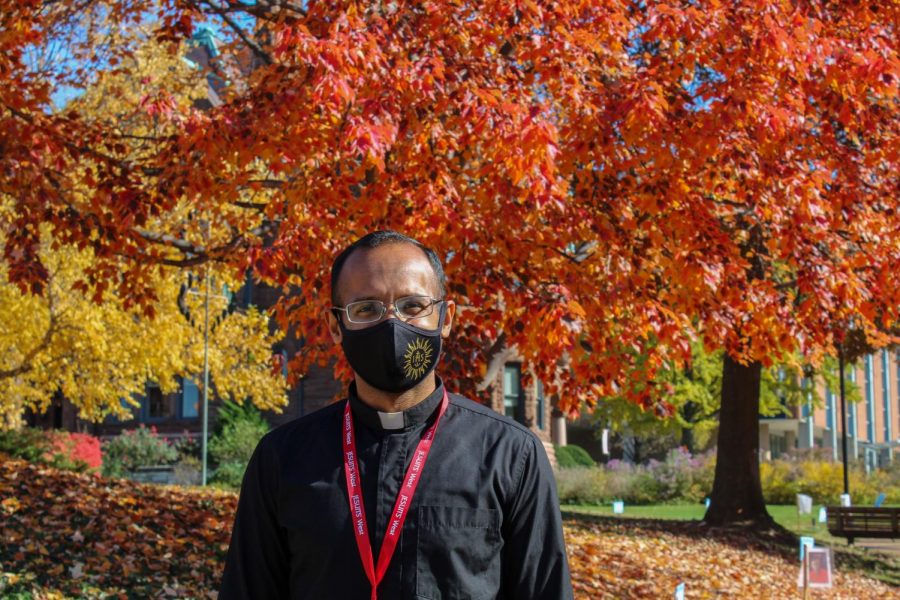
Daniel Mascarenhas, a prominent member of SLU’s Jesuit community, has an overall high opinion of SLU’s handling of COVID-19.

“I have the opportunity to go to classes in-person,” Mascarenhas said, “They’ve been hybrid so it’s great to have the flexibility for students who cannot come in person for any reason, they can still join, and those who want to be in person have the opportunity.”

The communication SLU has provided to its community is also a high point, from what the Jesuit told U-News.

“That’s been really helpful to give clear guidelines as to what are the acceptable behaviors, the best practices and the general cheerleading has been helpful to maintain morale.”

However, Mascarenhas has concerns regarding the feelings of community that SLU hasn’t particularly fostered.

“I don’t know what the solution to that [disconnection] is, but probably over the next three months, if the university, or perhaps campus ministry, could think of something of how to involve students so that they can feel a sense of community.”

In spite of this, Daniel still believes that SLU’s course of action is for the best.

“Nobody actually asked for COVID, so I think we’re responding to an external circumstance.”

Katherine Johnson

Photo Courtesy of Andrea Porter

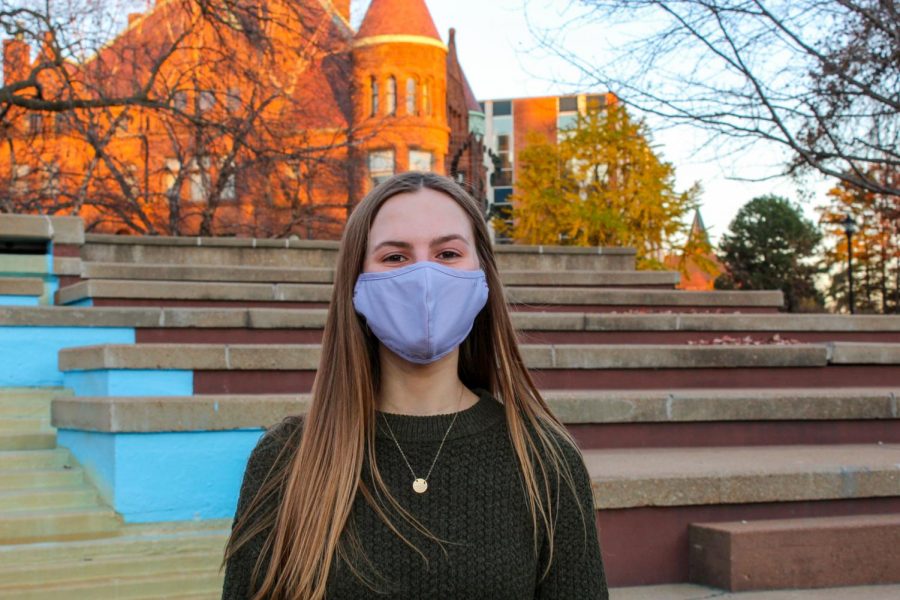
Sophomore Katherine Johnson also reports an overall positive experience, albeit with some issues.

“At least from the schools from my state, they [SLU] did a lot better,” said Johnson, “but I don’t know about it compared to other states. Based on Oklahoma schools, they’ve been doing so much better, especially with cases.”

Regarding COVID-19 testing at the university, Johnson told U-News that she wished that some things had gone better.

“Letting everyone get a test when they came back is really good,” said Johnson. “But the fact that they’re charging people to get one before they leave, I think it is not a good way to handle this.”

Johnson also reports issues with dining at SLU.

“Everytime I try to get food with my friends, it’s always so packed. People will stand right behind me and ignore the stickers, which is kind of frustrating.”

However, regarding her whole experience this semester, Johnson still maintains that the overall impact from SLU’s handling of COVID-19 has been positive.

“There could’ve been a lot worse, I could’ve been forced to stay back home,” said Johnson. “Besides, being able to come back here, see my friends again, and having in-person classes has definitely helped me stay on top of things.”

Terri Rebmann

Photo Courtesy of Saint Louis University

Terri Rebmann is a Professor in the Department of Epidemiology & Biostatistics, Director for the Institute for Biosecurity and Special Assistant to the President. Overall, Rebmann spoke highly of the COVID-19 plan SLU’s interdisciplinary team put into action as well as the participation of students in the plan.

“There’s just a huge amount of credit that needs to go to the students because our team, which was administrators, faculty, staff, and student representatives, put together the comprehensive plans and policies, but it’s up to the students to actually follow those policies,” Rebmann said. “So the fact that the vast majority of students followed the rules and followed them consistently is really a testament to the students.”

Rebmann also reported feelings of pride for SLU’s contact tracing program.

“Within the same day they get a positive test result for a student, they reach out to that individual and do the contact tracing, and put the close contacts into quarantine.”

Regarding any potential improvements for the spring semester, Rebmann states that SLU will be figuring that out over the winter break.

“There are lessons learned from this fall that can help us develop or enhance our plans for spring,” Rebmann said. “We need to keep campus safe, but there are possibly additional things we can add, such as more organized social activities if we do them in a very safe manner.”

Dan Kozlowski

Photo Courtesy of Andrea Porter

Communication Department Chair Dan Kozlowski also spoke very highly of SLU’s handling of COVID-19.

“I mean it’s been a challenging environment, I think for both students and instructors,” Kozlowski said. “When the semester started, I had some skepticism as to how things would go and I think, all things considered, we did pretty well.”

Particularly regarding the flexibility SLU gave students about being online or in-person, Kozlowski held many praises,

“The sense that the University got, I think, from the survey they had done over the summer is that most students prefer in-person classes, but some students, for a variety of reasons, needed to take classes online and I think SLU did a good job accommodating that.”

Kozlowski reported that overall he did not really have many problems with SLU’s handling of COVID-19.

“I mean I don’t think there’s anything that I’ve seen that has been a glaring omission,” says Kozlowski, “I think the University will have to make sure to keep reminding and encouraging folks to keep following COVID protocols if we’re going to have a successful spring semester too.”

Kozlowski, however, reported facing struggles to juggle engagement for both online and in-person students.

“I always want my classroom experiences to be positive for everyone, and I’ve struggled at times to make sure that students who are online, either on a given-day or for the whole semester, are still engaged with the class, that they’re still learning and having a positive experience.”

Weronika Grajdura

For Courtesy of Andrea Porter

Freshman Weronika Grajdura believes that SLU has handled the pandemic well, all things considered.

“There are some things that I’m not completely satisfied with or I thought they could’ve done a better job with,” Grajdura said, “I feel like we did better than other schools in that our infection rate was very low compared to other schools.”

Similarly to Kozlowski, Grajdura also praised SLU for the flexibility that they gave students.

“I think it’s nice they gave students the choice to Zoom into classes when they weren’t feeling well.”

Grajdura reported that she definitely had some issue with some other students.

“I definitely heard of some instances of partying and some people getting off easy, so that could have definitely been better,” said Grajdura.

Though she maintains a good opinion of SLU’s handling of COVID-19, Grajdura did report to UNews about that the lack of active clubs felt unnatural.

“It’s not the typical college experience and could’ve been better, but I feel like with COVID, SLU did a pretty good job.”

What Does It Mean For SLU?

Overall, it would seem that SLU has handled COVID-19 pretty well, all things considered. This handling was not perfect, as evidenced by complaints regarding areas such as dining and a lack of community events, which means there is still plenty of room for improvement. However, by their demonstration of transparency, flexibility with regards to taking classes and comprehensive guidelines, it would seem that SLU is certainly on the right track for handling an in-person semester during the pandemic.

This version of the story has been altered to fit AP Style Guidelines. The original story was published on Nov. 24th, 2020 on unewsonline.com. Click here to view to original story