“Cadaver” Has Promise, But Ultimately Drops Dead

Poster Courtesy of Wikipedia

Given the lasting popularity of film genres like horror within cinema, finding new and original ideas for stories can become a very tall order. However, it is not only a matter of originality of these films, but also of quality. The Netflix International film, “Cadaver,” certainly does bring some freshness to the genre. “Cadaver” (Norwegian: “Kadaver”) is a Norwegian horror film directed and written by Jarand Herdal. It depicts a post-apocalyptic society in the aftermath of nuclear disaster, where famine is widespread. Leonora (Gitte Witt), along with her husband Jacob (Thomas Gullestad) and her daughter Alice (Tuva Olivia Remman), struggles to continue on within this cruel environment, until one day they receive an opportunity to attend a theatre night at a hotel run by Mathias (Thorbjørn Harr), where they are promised a free meal. The theatre event is interactive, spanning throughout the hotel, in which guests are enabled to follow whichever actor they choose and must wear a mask to distinguish themselves from the actors. However, after some time, it is revealed that this event is much more sinister than Leonora or her family had initially realized.

The premise of the film is certainly unique. What especially helps “Cadaver” in this regard is the ways in which the movie sets up the atmosphere and the world in which the protagonists live. The film does a good job of showing, not telling, especially regarding the city landscape where you can see run down buildings, dead bodies littering the streets and the fog that constantly surrounds the city. Life is miserable here, and the film shows it.

The cinematography also deserves praise for helping set up the atmosphere. The panning shots of the city emphasize how life in general has declined in this reality and the outlook of everyone is in despair. Conversely, the tracking slow motion shots of the hotel not only serve to establish the order of the hotel, but how unnatural and creepy the hotel actually is. The change in color scheme between the locations in the film also helps to keep them distinct. Shades of greys surround the city to emphasize the dullness of life, whereas combos of red and black within the hotel’s halls communicate a sense of imminent death within the hotel.

The clear stand out character within “Cadaver” would have to be Leonora. Gitte Witt’s performance conveys to the audience a mother who wants nothing more than her family, particularly her daughter Alice, to experience happiness. It is her belief of imagination and innocence that leads Leonora to choose to attend the theatre event to please her daughter, though at the end it is her resilience that makes her a character the audience wants to root for.

However, this is where “Cadaver” begins to fall apart. While Leonora is a great character, none of the other characters within the movie feel compelling. Jacob, Leonora’s husband, really only has one facet to his character—serving solely as a generic father—and lacks much of the complexity that makes Leonora interesting. Mathias, the antagonist of the film, feels somewhat similar to Jigsaw from the Sawfranchise. However, the lack of a compelling backstory for his life outlook just makes him feel less captivating as a villain. The other side characters, like Lars (Kingsford Siayor) or Katherine (Maria Grazia Di Meo), are also just kind of there, not really engaging in any particular way.

The story, while unique, also gets rather predictable at times. From the very beginning when Leonora and her family are invited to the hotel for the play, there are all sorts of tell-tale signs foreshadowing what’s going to happen. They are given tickets at whatever cost they can afford, Mathias allows their daughter Alice to enter even though children aren’t initially allowed, and other attendees also reveal a differing experience about how they came to see the play. This information is communicated way too early on, leaving it no secret what is going on in the hotel. The film also ditches the “what is real” motif about midway through the movie, diminishing the intrigue of the story. Overall, “Cadaver” is a mixed bag. If you want to see something a little different, watch it. Otherwise, stay away.

This story was originally published on Nov. 11th, 2020 on unewsonline.com. Click here to view the original story.

Assessing Student Opinion of #CampusClear

Image courtesy of Grace Dunlavy / The University News

In the mist of the current COVID-19 pandemic, it is paramount to be able to prevent the spread of the virus and identify individuals who are infected with it. When in-person classes began to resume at SLU back in August, viral spread was a major concern. Even now, in spite of having an initial low percentage of students with COVID-19 during the move-in, SLU still has concerns about the virus given how students still move around on and off campus. One method that SLU is currently utilizing to track the virus is #CampusClear.

#CampusClear is an app that enables students, faculty and staff to regularly report any of 11 symptoms of COVID-19, as well as if they have tested positive for the virus or have been in contact with someone who has. The app is available for iOS and Android devices, and students are required to use the app daily in order to access parts of SLU’s campus. Depending on their responses, they will either be cleared to attend classes and come to campus or will be instructed on what to do next. 

Just as it’s vital to develop new methods to track COVID-19, it’s also equally as important to assess student opinions regarding their new methods. For the most part though, it would seem that the overall opinion regarding SLU’s usage of #CampusClear seems to be positive. Sophomore Jonah Wright, who previously had to quarantine as a result of his roommate getting COVID-19, spoke well regarding SLU’s usage of the app.

“I think it’s a good thing to do,” said Jonah, “I think at least the attempt to keep people accountable for how they’re feeling, whether they’re asymptomatic or not, is probably good.”

An anonymous upperclassmen also reported having positive emotions of SLU’s use of the app.

“I think it’s pretty smart that we’re using it,” the upperclassmen said. “I think it’s definitely helpful in keeping track of cases.”

However, just because student opinions overall seemed to be positive, that didn’t necessarily mean there weren’t any concerns to be had. One worry echoed by some students is the dishonesty regarding self-reporting, which sophomore Anna Richards shared with UNews.

“People could be not being truthful about their symptoms just so they don’t have to quarantine,” said Richards.

Another issue brought up is how some students don’t participate in using the app. The anonymous upperclassmen who reported a positive overall opinion of the app also had this concern.

“I’m concerned about that [students not using #CampusClear] because we are trying to keep our cases low to stay on campus, and if not everyone’s doing it, kinda a concern.”

However, in spite of these concerns, it seems that SLU students still believe that, to a certain extent, the usage of #CampusClear is effective in helping the university monitor students with symptoms of COVID-19.

“I think it is effective because it holds people accountable to check their symptoms every day… to step back from the rush of college life to ask themselves about how they’re feeling,” Richards said. “But only to a certain extent because students are not being tested as frequently as they should be.”

“It’s hard to say. I think it’s probably effective to some degree, so I think it’s a good thing that it’s in place,” said Wright. “But, I don’t think it’s a hundred percent effective obviously. I would say, yeah at the end of the day, it’s effective, but it’s not a hundred percent effective obviously.”

These concerns again tie back to student honesty regarding #CampusClear’s self-reporting, though for SLU students it seems, any way to help identify COVID-19 cases would be welcome.

This version of the story has been altered to fit AP Style Guidelines. The original story was published on Oct. 27th, 2020. Click here to view to original story.

“Books of Blood” Is A Bloody Mess

Poster Courtesy of IMDb

“Books of Blood” was the anthology book series that helped to launch now famous horror novelist Clive Barker into the forefront of the horror genre. Now, Hulu attempts to adapt Barker’s work into an original film for their streaming catalog. Directed by Brannon Braga, the film, similar to last year’s “Scary Stories to Tell in the Dark,” is split up into several separate segments that all end up connecting to one another. The first is about a young woman named Jenna (Britt Robertson), who suffers from misophonia, the extreme irritability towards particular everyday noises, on the run from her controlling mother which leads her to a strange and disturbing bed and breakfast. The second is about Mary Florensky (Anna Friel), a psychic researcher, who enlists the help of Simon (Rafi Gavron) to communicate to her deceased son Miles (Etienne Kellici). Simon claims to be able to talk to the dead. Lastly, the third segment is about a hit-man named Bennett (Yul Vazquez) and his hunt for the legendary Book of Blood. 

If there was a word to describe the overall feeling of Hulu’s adaptation, it would most certainly be dull. Nothing about this rendition of “Books of Blood” feels engaging, and instead just feels like any other generic horror film. A big part of this feeling stems from the acting within the film. Nearly every single character within the film, regardless of which segment they’re in, is portrayed in the most monotone way possible and displays nothing that even resembles emotion. For instance, within the second story regarding Mary Florensky’s quest to communicate with her son, there are several scenes in which she is supposed to feel anger and distress regarding attempting to communicate with her son and whether or not his messages are real. However, Anna Fiel’s performance within these scenes never feels genuine, and as a result the viewer does not really care about Florensky’s struggles. The only individual that does somewhat succeed in conveying some emotion is Britt Robertson’s portrayal of Jenna, namely when she tries to escape from the tortuous location she winds up in. However, even this can only demand so much praise as it has been done in other horror films and has been done better.

The music also contributes to the generic feeling of the film. Even though it initially gives off eerie vibes during the early stages of “Books of Blood,” as the film continues on the initial eerie feelings become lost as the viewer gets acclimated to the music and as there’s no real variance within the music, the overall atmosphere of the film shifts from somewhat disturbing to extremely bland. This also makes every one of the three stories feel exactly the same, in spite of how different these stories are. Jenna’s struggles to get away from her controlling parents should feel unique from Mary’s wishes to talk with her son, yet they do not.

While on that subject, the biggest overall issue with “Books of Blood” is the stories themselves. There is no real coherency even within the individual stories themselves, instead appearing as if events are occurring at random. One notable example of this happening occurs within the third story during Bennett’s quest to find the Book of Blood. His partner, Steve (Andy McQueen), eventually ventures off within a haunted neighborhood because he claims to be talking to his deceased mother. This detail pops up out of nowhere, making the event just come off as a forced way to deliver some uneasiness and scares within the third story. Pacing is another issue that is prominent throughout the film. The first story with Jenna drags on too long, soaking up around 46 minutes of the film, with the other two stories taking less time than that. 

In fairness to this movie, some aspects of the sound design, particularly how it portrays Jenna’s misophonia by emphasizing sounds like chewing, is kind of clever. At the end of the day, though, Hulu’s “Books of Blood” does the unthinkable: it makes Clive Barker boring. For casual viewers and horror buffs alike, there are better ways to be spending your October.

Originally posted on Oct. 27th, 2020. Click here to view the original story.
“Survivor: Winners at War” Doesn’t Quite Outplay Expectations

Few TV series have the ability to stay on the air for 20 or more years, yet one show that has managed to outlast its competition is Survivor. First hitting TV screens back in the year 2000, Survivor captivated audiences with memorable castaways and various layers of social strategy. Fast forward to December 2019, Survivor announced that, to celebrate the show’s 20th anniversary, the 40th season would consist entirely of previous winners. Expectations were understandably sky-high, as an all-winners edition of Survivor was something that has been discussed by fans for years. Now that all episodes of the season have aired, it must be said however, that “Winners at War” just didn’t live up to the hype.

*Some Spoilers Ahead*

The first issue to be had with “Winners at War” is that it doesn’t quite feel like it celebrates all forty seasons of the show. For one, the imbalanced chosen cast of 12 “new-schoolers” to eight “old-schoolers.” To be clear, “old-school” Survivor refers to the first 20 seasons of the show (from “Survivor: Borneo” to “Survivor: Heroes vs Villains”) and “new-school” Survivorrefers to the later 20 (“Survivor: Nicaragua” to this season). The two categories have differing aesthetics and types of twists. The two are also different in how they choose to highlights players, and to an extent in the strategy (though there’s overlap). So, when the show casts more newer winners than older—there’s only three winners from the first 10 seasons, but seven winners from the last 10—with two old-schoolers winning in more modern seasons, it just gives off the sentiment that the show is more so celebrating the latter half of its history. The second reason for this sentiment comes from the challenges. Even though host Jeff Probst in pre-game press described the challenges hailing from all past seasons, a majority either originate from the latter 10 seasons or are the most recent variation of the challenge. This is an issue, as many of the newer challenges lack variety: the pre-merge challenges are typically all obstacle courses followed by a puzzle, and the post-merge challenges are mostly individual endurance tests. This ends up making the challenge segments really repetitive and boring.

The second major knock against this season is the editing. There’s no real coherency between episodes and as a result you don’t feel like you’re getting the full picture of what transpired in the game. Alliances are created seemingly out of the blue, alliances fall apart without any real indicator as to why, and massive in-game threats fail to bet targeted without any reason. The presentation of the social strategy feels sloppily stitched together, instead favoring to highlight less interesting aspects like the advantages.

Speaking of which, there are way too many twists and advantages within the game. This article isn’t going to explain what each one does as that would take a while, but some of the many twists included: 10 immunity idols, a lot of Fire Tokens (the new in-game currency), the Safety Without Power Advantage, the Steal-A-Vote Advantage, an Extortion Disadvantage, a Challenge Disadvantage, and the Edge of Extinction. A vast majority of these twists aren’t interesting, and instead soak up time from what the viewers want to see: the players. The draw of the season is to see these all-stars from different periods—like Boston Rob and Jeremy, Kim and Tony, Yul and Sophie, etc.—interact and play with each other, not what they thought of all these advantages.

In fairness to this season, there were some positive aspects to it. Watching the gameplay of Tony Vlachos, Kim Spradlin, and Michele Fitzgerald was a treat. Seeing them navigate their way through the various game scenarios, especially as the former two overcame big targets on their backs, solidified their status as great players. The premiere episode was great, the confessionals were amazing, and the winner was satisfying. However, as a whole, “Survivor: Winners at War” was a letdown, especially considering the hype preceding it.

Originally posted on Oct. 7th, 2020. Click here for the original story.

“Transformers: War for Cybertron Trilogy-Siege” Is More Than Meets The Eye

Despite sharing a name with the 2010 video game “Transformers: War for Cybertron,” the first chapter of Netflix’s anime miniseries trilogy bears no connections. However, the premise of both mediums is the same: a telling of the events during the waning days of the War for Cybertron that took place between the Autobots and the Decepticons. In spite of a delayed release as result of the current COVID-19 pandemic, Allspark Animation’s and Polygon Picture’s six episode miniseries, “Transformers: War for Cybertron Trilogy-Siege,” is now available for viewers on Netflix. Fortunately for fans of the long running series, this new retelling delivers on multiple fronts.

The first thing to bring up is how surprisingly deep the story is. Both sides of the Autobot-Decepticon conflict view themselves as the heroes of the story, the ones that will ultimately restore Cybertron for the betterment of all. This is made explicit through tellings of life before the war: the social stratifications between the Autobots and Decepticons, the origin stories of Optimus and Megatron, who individual players (like Ratchet or Impactor) were before the war and much more. 

As the war carries on, continually ravaging the planet while also depleting their energy reserves, both sides grow more desperate and turn to more extreme solutions, causing much dissension between the ranks of both sides of the conflict. None of this ever feels hamfisted, instead drawing one into the events that transpire within the six episodes that comprise this first chapter. 

The viewer really ends up getting a sense of everyone’s viewpoint and their status within the conflict. They begin to understand the tension between Optimus and Megatron, why some Transformers like Ratchet end up staying neutral, why some subsections like the Decepticon Seekers end up fostering much dissent and more. By the end, the viewer becomes so invested within the story that they end up wanting more, which is the ultimate sign of great worldbuilding and storytelling.

Speaking of characters, Netflix’s rendition of the titular franchise doesn’t disappoint in its depiction of the iconic cast of Autobots and Decepticons. For the most part, the characterizations of both sides are on point—remaining faithful to previous iterations of the characters as well as adding new facets to some iconic characters. Some good examples include Optimus Prime, who is portrayed as a more inexperienced leader, yet still just as stoic; Starscream, who’s deceitfulness is portrayed in a moral realistic manner this time around; and Megatron, who’s portrayal as a violent revolutionary is a welcome addition. However, not every depiction is perfect, most notably the voice work of Soundwave by Edward Bosco leaving a lot to be desired.

Of course, “Transformers: War for Cybertron Trilogy-Siege” is a CGI Anime series, and for the most part, it looks pretty slick. Everything from the movement of the characters, the rendering of the environment and the action sequences are great. The fight scenes in particular make use of some clever choreography that make use of each character’s abilities like Mirage’s illusions and Jetfire’s flight. Overall, “Transformers: War for Cybertron Trilogy-Siege” is a solid new adaptation of the Transformers. With solid worldbuilding, believable characters and overall great visuals, Netflix’s rendition of the Robots in Disguise is certainly worth a watch. For longtime fans and series newcomers, definitely give this one a watch.

Originally posted on Oct. 6th, 2020 on unewsonline.com. Click here for the original story.

The Invisible Man: Catch Him If You Can

After failing to move forward with the Dark Universe of classic monsters, Universal Studios rebounds with more individualized storytelling in their latest rendition of “The Invisible Man.” Loosely based on the H. G. Wells novel of the same name, the film depicts Cecilia Kass (Elisabeth Moss) and her struggle to get away from her abusive boyfriend, Adrian Griffin (Oliver Jackson-Cohen). After Cecilia manages to get away with aid from her sister Emily (Harriet Dyer) and their childhood friend James (Aldis Hodge), Adrian takes his own life, but leaves Cecilia a large portion of his fortune. After a series of bizarre events unravel, it soon becomes evident to Cecilia that Adrian may not be as dead as she thought and is now tormenting her.

This movie excels in its creation of tension through its score, its handling of scares and the cinematography and camera work. The way scenes are set always gives the eerie feeling that someone is watching. Long shots and unbroken shots are used to great effect, often showing Cecilia or one of the other protagonists from another room or following them through the environment. This creepy feeling is also aided by the movie’s soundtrack. The slow-burning music, aided by clever usage of instruments like piano or violin, helps to keep you at the edge of your seat. Given that this is a horror movie, the scares have to deliver, and for “The Invisible Man,” it does. Moving items, Cecilia and crew being attacked despite no visible danger, reveals of the Invisible Man and a particularly unnerving scene involving a phone call help add to the eerie presence of our antagonist.

Of course, a technically well-made movie is not worth much without solid acting, and in that regard, “The Invisible Man” also doesn’t disappoint. Aldis Hodge is believable as the childhood friend to the Kass sisters, a cop and the father to Sydney (Storm Reid). Oliver Jackson-Cohen and Michael Dorman both do a solid job as the film’s antagonists, bringing sinistry and uneasiness to their to the story. However, the standout is without a doubt Elisabeth Moss. She anchors the film with her convincing performance of a victim of an abusive relationship, someone looking for escape. She really begins to hit her stride toward the climax of the film when her character is sent to the asylum, as you can see through her facial expressions that she has been through hell, that she is emotionally fractured, yet can still recover to be a fierce and determined individual. If there is a weak link in the cast, that would easily be Harriet Dyer as Cecilia’s sister Emily. When she is helping Cecilia, you really are not that convinced that she cares for her younger sister, and when she begins to distance herself, you also don’t quite buy the fact that she is angry with Cecilia.

While on the subject of the movie’s weak points, the ending of the film leaves a lot to be desired. There’s a difference between a complex ending that gives thought towards the film and a sloppy finish, with “The Invisible Man” falling towards the latter of the two. The twists that director Leigh Whannell throws seem to attempt to mirror his previous work with “Upgrade” (2018). However, the twist this time feels just, well…what?! The film ends much more naturally on the scene after the final confrontation, but what continues afterward feels really unnecessary and calls into question previous events in the film. There are also a couple scenes, particularly near the end, where it was obvious to viewers that security cameras would catch Griffin as he begins to kill people in front of them.

Overall, “The Invisible Man” is a good movie, but short from great. While it is technically well made, has overall solid performances and plenty worthwhile scares, several story elements that arise toward the climax of the film prevent it from reaching its full potential. If you’re a fan of horror movies or just want something decent to watch, then this film will be worth your time.

Originally posted on Mar. 4th, 2020 on unewsonline.com. Click here to see the original story.

Through a Different Lens: SLU Film Studies Director Talks Getting into Film and What He Wishes for Students

[ST. LOUIS, MO] – A common mindset for students who engage with Film Studies in college is to head off to Los Angeles, to take part in the expanse known as Hollywood. However, while the professionals of tomorrow might be preoccupied with big stars and corporate studios, the director of Saint Louis University’s Film Studies program aims to show students another direction. 

Alexander Rafi, an independent documentary filmmaker, had an unconventional path within the film industry. Being dragged into it by his friends in his high school’s film program, Rafi had come to have a deep fundamental understanding of films and the process by which they were created.

“ I was often helping out,” Rafi said. “I was crewing, or more often than not being in their films, as they were making fiction films and they only had so many friends. I was a decent actor.”

Such a history embedded in media is what enabled Rafi to study Communication and Cinema Studies at the University of Pennsylvania. Since then, Rafi earned a Masters in Documentary Film at Stanford University and produced several films, including A Door Away and On Task. Rafi is a professor of media production at Saint Louis University, taking over their Film Studies minor program after the departure of Ringo Jones.

Rafi sat down for an interview at SLU’s Communication Media Center (CMC), talking about his history with film, his approach to being a professor and takeaways from how to succeed in the entertainment industry.

Q: When you got into the communications and film program at your college, who was a professor who stood out to you during your time and what were the messages you took to heart and still carry?

A: His name was Paul Messaris. He was a visual communications professor who was very interested in film and the film industry…The biggest lesson that I learned from him was honestly that although people had this idea that you have to work your way up from the mailroom, no one actually makes it that way.

He was very good about providing examples, and he actually explained to us how Steven Speilberg actually kind of fell into being a director sort of… that made me realize that if I wanted to do some kind of filmmaking, I have to start doing it and I have to look for programs where I can actually do it.

Q: So you got out there and worked for your college. Was this just freelance work or were you involved with student organizations?

A: It was a mixture of freelance and student organizations. I was part of a filmmaking club that I joined during my junior year, where the whole point was to make fiction films. We won a couple of awards at a student film festival.

I did a couple of commercials and investor videos for the start-up; I was doing videography for student groups [on-campus]; I was in a theater group and I did most of the videography, recording our plays and events… I messed up a lot unfortunately, but I learned how to not mess up so much, and had generally a lot better experiences as I got more experience doing it on my own

Q: You talk about things you wish you could’ve done differently. Can you talk about how you learned to let go and be more accepting of, as you said, “let it be a product of the time it was created?”

A: My first documentary that I would call a “film,” I made at the end of my sophomore year and essentially made it in three weeks. There’s only so much you can do in three weeks [laughs]. I remember that something funny that happened on my first day of grad school was like “Yeah I’m excited to have a bit more time to work on my projects,” and my professor and colleagues were laughing.

A lot of the things that fall apart on the film set have nothing to do with you, they have to do with the circumstances and if they have to do with you, it’s something you couldn’t anticipate or couldn’t plan for. Having that space and understanding [helps], that if the film works, people are going to watch it and maybe it wouldn’t have as big of a platform as it could have had everything went perfectly.

Q: Obviously you’re a teacher now. How did you get into it and how did you wind up at Saint Louis University in particular?

A:  So with the arts especially, there are people who are full-time artists, but that is a lot more rare. Most people who do a creative practice do that and some other thing, whether that’s contract work for companies, doing some teaching, or a mixture of other things. 

For me, I knew I wanted to be teaching after college… I enjoyed seeing people grow and develop and also just being a resource. A lot of younger people, both high school and undergrads, most of their teachers are older: late 30’s, 40’s, 50’s, et cetera and in college the ages go up even more.

Q: 80’s?

A: Exactly [Laughs]… I think it’s essential for you to see someone who’s newer in their career, and has a better idea of what it’s like being 22 in the current era.

Q: Did you know about the Film Studies Minor before you came to SLU or did you find out when you got here?

A:  I knew about it, the Film Studies minor, before I came to SLU… Dr. Kozlowski, who was the interim chair and now current chair, mentioned it as a possibility.

I knew coming here and being able to do something in Film Studies, and kind of create a bit more standardization, in some ways would be helpful to students. Now, I’m really excited because I get to start doing some of the fun stuff now that COVID is kind of subsiding. Building partnerships with local film places, creating film events on campus potentially and making it fun for students.

Q: What specific organizations do you specifically talk to try and get students more connections in the industry?

A: I’m thinking less about big organizations, though I think it would be beneficial to try and create a relationship with Cinema St. Louis again… I think meeting former students who do things like hosting podcasts because they’re a comedian, or seeing people who came through this environment who are going on to work in the field, is really helpful. 

My real thing that I want to do is bring like other professionals, not necessarily folks who are St. Louis-based, but folks who work in different facets of the entertainment industry to do master classes, workshops, or just talk to students. And because of Zoom, we don’t necessarily have to bring them in, and we can have virtual workshops and master classes.

Q: Across the classes you teach, like “Video Production” or “Documentary Production,” what are the ideas you’re hoping students obtain?

A: I think the main thing for me is that creating media is a process and the components, regardless of the form of media you are making, are actually oftentimes very similar. There’s always pre-production, production, post-production and distribution.

I think knowing that there are these stages to the product, that “I don’t have to create something out of nothing” instantly is the main thing… I’m doing the same thing in other fields. If I’m writing a paper, there’s research, I go out to produce the paper, we edit the paper, [and] we distribute the paper.

Camp Moval Adjusts After Being Shut Down For 2 Years Because of Pandemic

[ST. LOUIS, MO]- In the forest landscape of Union, just off Highway UU on the aptly-named “Camp Moval Road,” lies an outdoor ministry known as Camp Moval. Upon first impressions, Moval would appear as just another summer camp. Many of the usual camp activities are present across 280 acre space. Various hiking trails, a high ropes course, an archery range, a lake and several cabins serve as some of the main features of the camp. 

However, a deeper look will reveal that Moval is more than just a summer camp, it’s a spiritual community. Functioning as an outdoor ministry for the progressive United Church of Christ (UCC) since 1962, Moval is best defined by the inclusive community it aims to create through its annual summer programs, both for youth and families. 

Shelby Oberle, the daughter of a UCC pastor in Columbia, MO, has attended Moval since her early childhood. Recalling her fondest memories at the camp, Oberle says it was the community of Moval that kept her coming back.

 “It was kind of a tight-knit community we had going on every summer,” Oberle said. “There are so many [memories] that are triggered at random. I will remember sitting around [in a circle] while someone played a guitar, or when someone caused a dead tree to fall over by putting a hammock on it. Even the little things we did, like all the games, are things I really loved.”

Oberle was not alone in her experience of communal connection at Moval. Amanda Schmitt, the principal program coordinator who was hired in the spring of 2022, has also reported experiencing these same connections as Oberle. Schmitt’s experience with the UCC summer camp extends back to when she was seven years old, starting out as a camper until becoming a counselor at age 15.

“Obviously the activities were fun, but I think I kept coming back for the people and the connection,” Schmitt said. “Even things as simple as singing around a campfire, for me, was the most meaningful [experience]… you feel like you are part of a family.”

When she started serving as a counselor and staff member at Moval, Schmitt says emphasis was always placed on fostering growth within the campers who attended every week. 

“As a camper, the main goal is to challenge yourself in lots of ways, like putting yourself out there with new people or activities like our high-ropes course,” Schmitt said. “Also, to connect in a spiritual way with camp and enjoy being out in nature, which we don’t usually get to do.”

Pastor Erica Roth, who heads a UCC church in south St. Louis, also says she has felt a spiritual connection to Moval, where she has served as the director for several outback and special-needs adult camps over the years. Despite growing up with a separate UCC camp in Kansas, Roth became involved with Moval when she moved to the St. Louis region as a seminary student.

“It became a home away from home, a safe space to explore,” Roth said. “I do love Moval’s site… I liked being able to be out on the lake, and the cross and worship space outside of Red Cedar (staff cabin adjacent to the main lake).”

However, this summer worship community would come to face some severe challenges in 2020 and 2021. Despite initially planning for a 2020 summer season, the global COVID-19 pandemic forced Moval to cancel those planned events. Moval simply could not foster an in-person spiritual community without risking the health of the staff and campers. 

“When they talked about closing the camp because of COVID, people, myself included, were so upset,” Oberle said. “They were not able to go to their place anymore: to escape and get away from the real world. It means so much to people, and when they were not gonna have that, I was upset.”

This closing of the campgrounds extended through the 2021 year, as new variants of the virus had begun to infect the global populace. It was during these two years of inactivity that the Missouri Mid-South Conference UCC, a collection of 139 separate congregations in Missouri and several adjacent states, considered the possibility of closing Moval permanently. The “family” that campers and staff had formed faced the real possibility of being dispersed. Some individuals, like Roth, carried some frustration throughout the constant meetings and deliberations.

“I was on a lot of those Saturday calls, and being quite honest, I was disappointed in some of the decisions that were made,” Roth said. “I understand that you have to look at the viability of the place… I think some people are not camp people, and while they are not trying to be mean, I don’t think they understood what Moval meant to the people who went there.”

Fortunately for Moval, however, the Conference ultimately decided to allow the Union outdoor ministry to remain open. While the uncertainty regarding Moval’s future was over, there were still a couple of complications th​​at needed to be addressed. The previous site director, Jeremy Force, had left Moval to pursue other ministry opportunities, leaving Moval without a site director to guide staff throughout the summer. In addition, many of older recurring campers at Moval, notably for their high school camps, had gone on to graduate and were no longer eligible to be campers.

“I have a really active youth group, and over those two years we weren’t able to go, I think I could’ve gotten them to go, but now they are too old to start going to camp,” Roth said. “They sort of missed that junior high, early high school age [camp experience] where it really would’ve started to make a difference [socially and spiritually] to them.”

Not only did Moval need to rebuild the community that it once had prior to the pandemic, but also the campgrounds needed to be cleaned up. According to Schmitt, two years without any activity at the site had caused most of the natural walkways through the surrounding woods to be covered in leaves, weeds, and other debris that made walking amongst these paths difficult. Fortunately for the 60-year-old UCC camp, there were plenty of helping hands available to get Moval back to its pre-COVID form.

“Volunteers are kind of our life blood. We have so many positions in the summer, but we were really dependent on them outside of the summer” Schmitt said. “They helped with the upkeep of the grounds, as well as for new projects.”

With enough volunteers and staff on hand, Moval was able to reopen with programs throughout July and August, with a new site director in Kevin Zimmer. While the number of campers was lower in comparison to previous years, Moval staff still worked to build a strong community.

“Now that we have new leadership between Kevin and I, we are trying to think ahead and forward to make sure the camp continues to grow,” Schmitt said. “I just want to see it evolve and continue to connect with many different people.”

Much of that reengagement to evolve the outdoor ministry is encouragement of church youth to go out and spend some time at the camp. Roth has been doing retreats to the site along with her various youth groups, and says that she has experienced positive feedback from them.

“The middle school retreat is coming up pretty soon, and some of my senior high youth were like “I want to go help with it,” ignoring the age requirements of each camp,” Roth said. “I do think there’s potential there, and I see kids still experiencing the Spirit there in ways they don’t experience anywhere else.”

Such youth engagement is necessary should Camp Moval continue to maintain its summer services and evolve its current community. With promising new results under new leadership, Oberle says she is hopeful that, despite not being a camper anymore, she can continue to help the spiritual community of Moval grow.

“I’d like to still be a part of it through counseling, going to special events, and just helping keep it alive by spreading the word about it,” Oberle said. “When you are at camp, you are really focused on the spiritual aspect of the community, and being in nature helps you see the things around you.”

Communicating growth: U-News staff adviser helps students progress throughout SLU academic year

[ST. LOUIS, MO]- Staff members for SLU’s Student Involvement Center are known for their dedication in helping to foster the student community. Michelle Peltier, the web and media coordinator for the Center, brings this passion for community development to students aspiring for communications careers. Serving as the staff adviser for The University News since 2014, Peltier has worked to pass on her knowledge of journalism to many communications students.

Peltier cites her defining traits as resiliency and adaptability, which have helped her throughout her media career. Having started out writing for Vassar College’s student newspaper, Peltier was able to land a postgraduate internship with CBS News. Despite not getting hired initially after the internship’s end, Peltier continued her journalism work in Chicago and Charlotte, before eventually returning to CBS in an entry-level position.

“I worked my way up [at CBS]: starting as a production assistant and working on the newsdesk, then going into research and fact-checking for the evening news,” Peltier said.

“I finished my time there working on the cbs.com news site, as that became a bigger part of the business.”

Such experiences had taught Peltier valuable methods of identifying and researching relevant societal information, as well as relaying that information to her audience. While Peltier understood that these communication attributes are essential within any industry, switching from the hands-on, active position of reporting for CBS to the more hands-off, mentor position of U-News advisor did prove to be more difficult than she anticipated.

“When I first started advising, I was over-involved,” Peltier said.

“I felt that I needed to copy edit everything, I was suggesting story ideas more, and I was a little bit too much in the student’s business. I gradually had to recognize my role as moral support and backing up the students, even letting them make mistakes.”

This struggle to adjust to a mentor role should not be all that surprising, considering the different demands of teaching and on-the-ground reporting. Especially for Peltier, who did not actually seek out her position at the Student Involvement Center and the adviser of The University News. Instead, Peltier reports that she initially wished to study at the University of Missouri.

“I had come to Missouri to get my master’s in photojournalism [at Mizzou], and I found myself unable to do what I needed to do to pursue that position,” Peltier said. “[For a photojournalism career] you need to be able to pick up and move to whatever small market has a position available to then work your way up. I had both a newborn and a dying parent [to take care of], so I needed to be here.”

Peltier was eventually able to meet a mother who worked at St. Louis University, who then recommended a job in marketing and communications at the institution as a potential fit.

“I sort of stumbled into a position [in the marketing department], then after a year and a half, transitioned over to Student Involvement,” Peltier said. 

Despite how she ended up working with Student Involvement and the University News, through the support of College Media Advisers, an organization of newspaper advisers for student news groups, and fellow peers, she was able to acclimate to her new advisory role.

“I had to learn more about advertising, and the technical aspects of production,” Peltier said.

This support from Peltier has proven beneficial for the development of writers and editors at the University News. Diana Jakovcevic, the editor-in-chief for the University News, first joined the student organization as a staff writer during her sophomore year in 2020. Being a Communication major, Jakovcevic was eager to gain insight regarding the practice of journalism.

“It was rough,” Jakovcevic said. “I barely had any journalism experience, but knew that I wanted to learn more.”

As she was trying to figure out the nuances of journalism, Jakovcevic found a valuable source of insight and a companion in Peltier. This relationship ended up being essential for  Jakovcevic’s ascension to the position of editor-in-chief as well as her general development as a journalist.

“She was there to help,” Jakovcevic said. “Over time, I have opened up to her and we’ve talked about our families and similar past situations that we have experienced… It made me feel like I had a friend in this industry and someone to look up to as well.”

Peltier continues to serve as a valuable mentor for those like Jakovcevic who seek to expand their horizons, both within the University News and her general work with the Student Involvement Center. For Peltier, just being able to push students to be able to try something new is always a goal she strives towards, especially since she herself has experienced the need to adjust. 

“Whether that would be participating in a club or organization, having to do public speaking, or for a student on the newspaper having to interview a stranger on a subject… [is beneficial] I think for students,” Peltier said.

“We grow the most when we are stretching ourselves.”

Northern Involvement: Why SLU doesn’t match the surrounding community

ST. LOUIS, MO- Aric Hamilton, a local St. Louis native, is currently in his Junior year at Saint Louis University. Over the past year, Hamilton has been very involved within demonstrations on campus to help promote a more diverse and inclusive environment. 

“Personally, I have seen some amazing work from our institution and seen how it can be rooted in community both for and with folks, but I have also seen instances where that trust, belief, and the good work that we do can be eroded by some more negative interactions,” Hamilton said.

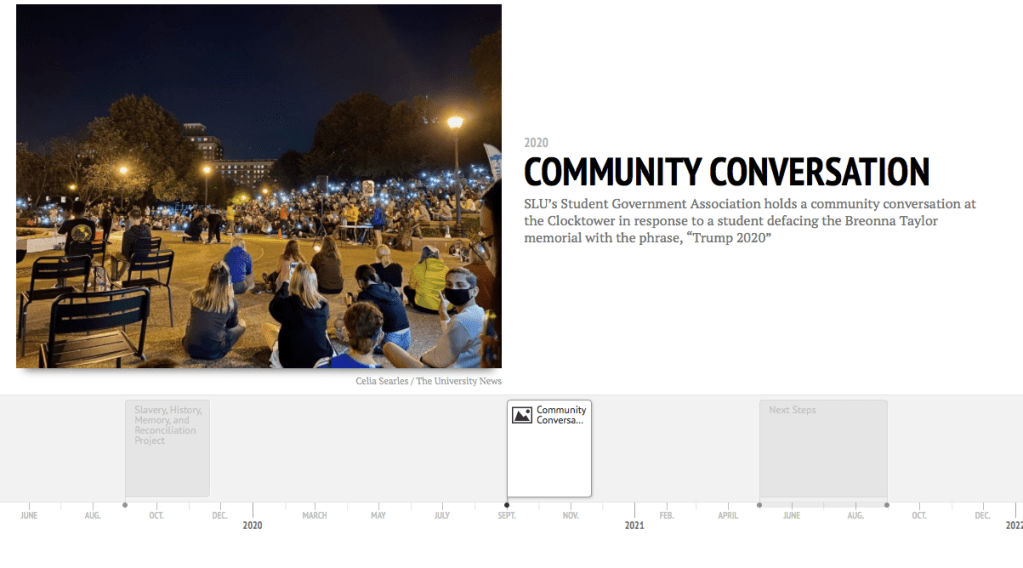
“It’s always going to be a tension point in terms of how we foster a sense of diversity, equity, and belonging amongst our students, faculty, staff, and administration.”

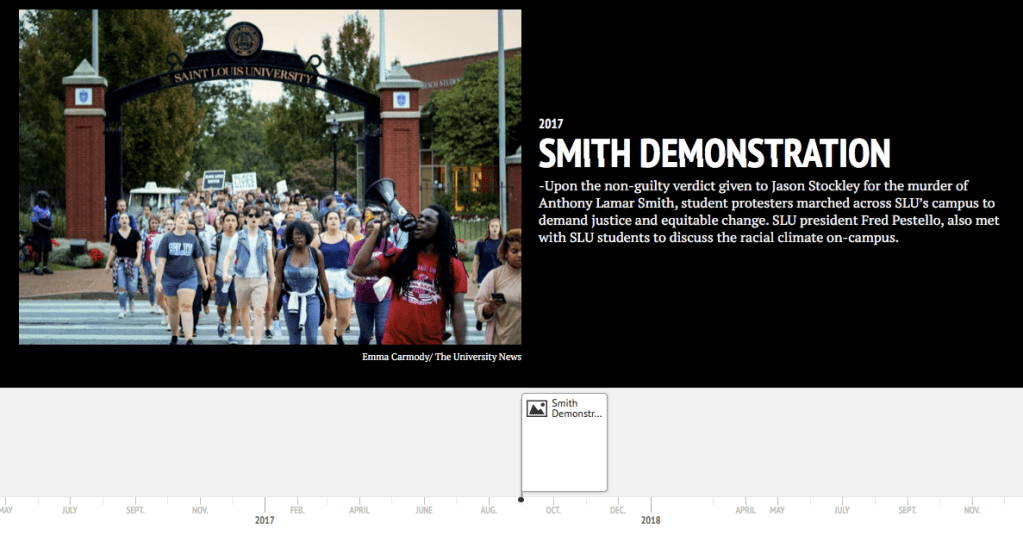
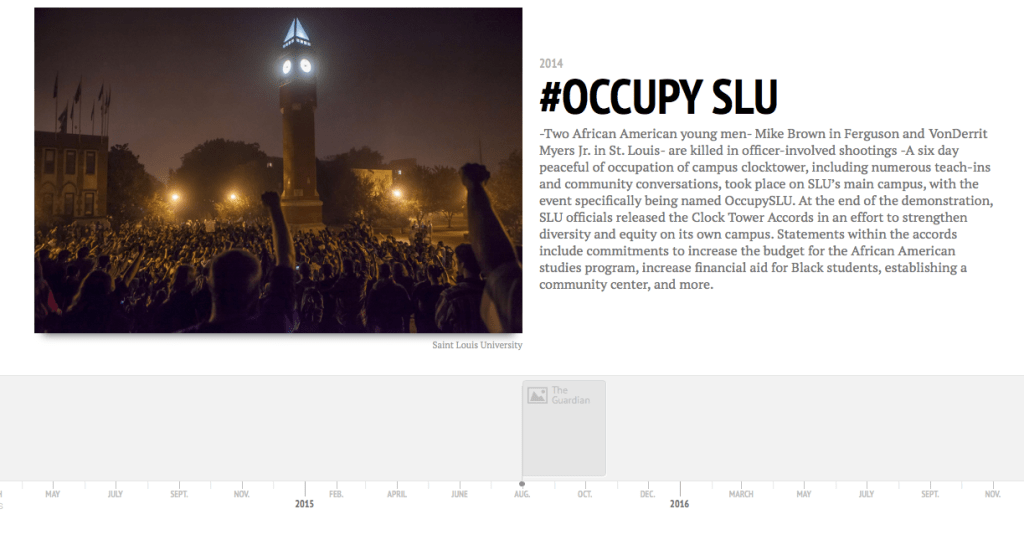
This tension described by Hamilton has been a long-standing issue for SLU. Saint Louis University was founded as a Jesuit institution, seeking to serve its surrounding community. According to SLU’s mission statement, one of the main points of focus for the university is to link its resources to the people of local-as well as national and international-communities to combat ignorance and improve the quality of life for all. 

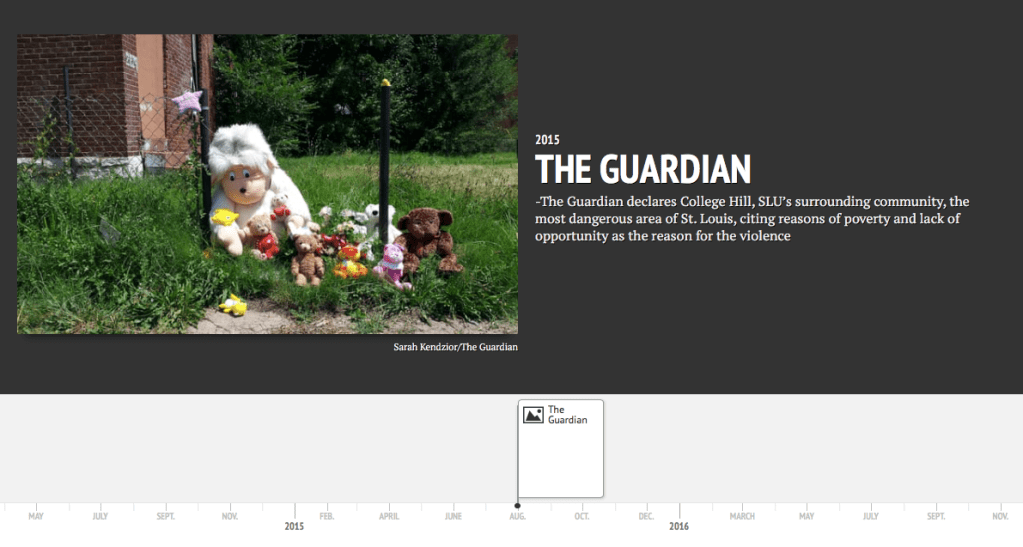
For reference, College Hill, the area surrounding Saint Louis University, fosters a population of 1146 people, with 92.2% identifying as Black. This African American majority is commonplace in many neighborhoods of North St. Louis-such as Hyde Park and Old North St. Louis-with even the city proper as a whole supporting a nearly even White-Black population split, with 46.5% and 46.4% respectively according to the recent 2020 census. 

Even though universities of any sort commonly enroll students from across the nation, it would not be totally unreasonable to expect SLU’s student body to at least reflect the diversity of the surrounding area, especially considering SLU’s Jesuit mission. However, according to SLU’s 2021 profile, only 5.5% of the student body identifies as African American, a far cry from the even split of St. Louis or the Black majority of College Hill. 

“Rather than invest in the community and young students in our backyard, SLU looks outward not giving these students a chance,” said Luella Loseille, the assistant director of diversity and inclusion at Saint Louis University.

According to Andrea Hitsman, the assistant director of campus visits for the Office of Admissions at SLU, a sizable portion of the University’s student body hails from out-of-state areas, even though COVID-19 has encouraged applicants to apply to more local institutions.

“As you know, most of our students are from the Chicago land area, within upper Illinois, but this year we have had an increase of students who came from the St. Louis area.” Hitsman said.

“We have been building territories in California and Texas.”

SLU’s history with racial discrimination does factor in this discontinuity. Loseille highlights how SLU only became desegregated during the 1940s, and African American students still encountered much unfair treatment. Numerous historical barriers-including high tuition costs, testing score requirements, and aforementioned discriminatory practices- have contributed towards the disproportionate student demographics that can be observed today. Hitsman also pointed to this historical trend as a deterrent for applicants of color.

“Saint Louis University is a Jesuit Catholic institution, and Jesuit Catholic institutions are historically, predominantly white colleges.” Hitsman said.

“There is also a historically black college [Harris-Stowe State University] literally right next door to Saint Louis University’s campus. Would we like to see more students of color on campus? More Black students? Absolutely.”

The neighboring Harris-Stowe State University certainly poses a higher population of students of color, with the University reporting 86% in the fall of 2018. This appearance of segregation from the two institutions can, according to Loseille, be traced back to the racial history of St. Louis: being a border state that supported slavery within 1800s. The status of bordering the Northern and Southern United States brought with it the clashing of values that created a lasting impact of segregation, even during the migration of southern African Americans during the reconstruction period.

Dismantling this divide requires meeting each other halfway, which is fortunately something SLU has attempted to combat in more recent efforts. SLU’s Cross Cultural Center hosts many services in order to provide support to historically underrepresented communities.

“We do this through efforts grounded in cultivating knowledge and engagement through intentional collaborations, experiences, initiatives and programming,” Loseille said.

“Such as Cultural/Heritage Month celebrations, Diversity Movie Series, International Education Week, Atlas Week, Audre Lorde Scholars Program, African-American Males Scholars (AAMS), Safe Zone Competency Program in addition to various workshops and trainings pertaining to diversity, equity, inclusion, and justice.”

Leah Sweetman, the assistant director of the Center for Social Action, lists several different student organizations currently involved within the communities of North St. Louis.

“There is an organization called Overground Railroad, and they focus on literacy, so they do a lot of tutoring and reading work with kids in a number of schools in North St. Louis,” Sweetman said.

“There are some other organizations. There are some student groups and honor societies who are working in ACT prepwork, college prepwork, high school prepwork, and other kinds of things.”

One unique program currently hosted by the Center of Social Action to provide education and promote diversity in the workforce is an aviation program. Assistant Director Leah Sweetman walks through some of details and current complications of the program.

However, with regards to the faculty of the Center for Social Action, Sweetman acknowledges that they are somewhat shorthanded with their massive workload.

“Right now, we have relations with hundreds of community organizations across the region, but we are a relatively short staff. We have five people on staff and some student staff” Sweetman said.

“We don’t have the capacity to be meeting with all our community partners regularly. If we had another staff member who could do site visits and work with a coalition of partners around a particular area, we could develop more opportunities for students.”

Sweetman was not alone in reporting areas of further development. Hitsman noted how, regarding community outreach, SLU’s Admissions Office was suffering a temporary setback-though SLU is in the process of fixing it.

“It [local outreach] doesn’t have a counselor in it, we were about to do a hiring process,” Hitsman said.

“What we’ll do is come up with a strategic plan on the number of students we would like to recruit from the local St. Louis area, and hopefully the admission counselor that gets this territory will work really hard to build relationships with the counselors, teachers, and principals from these high schools.”

If SLU wants to continue to advance its goals of achieving an equitable campus, then it is advisable that they quickly fill these gaps. 

“We have an office in place to help [international] students get acclimated to living in a totally different country. We can do that too for domestic students” Hitsman said.

Despite some of SLU’s shortcomings, Hamilton still maintains a positive outlook regarding SLU’s current work of diversity and inclusion.

“SLU has had an interesting place in my life. My mom attended SLU and graduated from Arts and Sciences in 1994” Hamilton said.

“Deep down, I really do love SLU and I don’t think I could have seen myself engaging in my undergraduate experience anywhere else.”